Showing posts with label matt grobis. Show all posts

Saturday, February 16, 2013

Nine months out of the college bubble (Matt Grobis)

Hi all!

As the one-year anniversary of me graduating approaches, I've had some time to reflect on my college experience and the ways it has - and hasn't - prepared me for graduate-level research.

1. Grades matter, but experiences matter more
Study for your classes. Good grades should obviously be a priority. But view your classes as the skeleton of your college experience; they are a base that you need to care for, but you need to add some flesh to it, too. From an academic perspective, your undergrad classes rarely come up in conversations in grad school... it's all about the work you did in the lab or field. Much more important to graduate committees (and your future self) are your experiences with research: what techniques did you learn, how was the experience different than what you expected, how did you overcome problems you encountered, how did it affect your perspective on science? There's a difference between loving X and loving doing X, and unfortunately a lot of people figure this out once they've already committed a few years to doing X, be it graduate school research, a particular field, etc. Get your hands dirty and figure that out now! If you realize it's not for you, you can redirect your energy to finding something that does make you happy. 

2. Try things out
Say "yes" to more opportunities you receive. Get out of your comfort zone. Second semester senior year, I had the opportunity to volunteer for bird banding - taking mist-netted birds (birds that were caught by flying into a thin, big net strung between two poles or trees) and giving them color rings so they can be identified later. The grad student who sent the e-mail needed the extra help, and in exchange we would learn how to band and handle birds. This was when I knew I'd be working with birds in Germany for the following year, so I said yes (even though the work started around 5am). Even the little bit I learned about how to properly hold birds, distinguish male vs. female characteristics, and identify potential signs of illness came in handy when i started doing research with birds. I also took a graduate-level statistical modeling class my final semester and, while I definitely didn't master all of the complex R coding we did, being exposed to that stuff really changed my perspective on modeling in science.  

And from a personal standpoint, I abide by the life philosophy that you should try everything at least once (except probably heroin and that sort of stuff). Attend a meeting for a random club, go to a play or performance you might not have given a chance to otherwise, call up a friend you haven't talked to in a while. The worst that can happen is exactly what would happen if you don't do it: nothing. And the best that can happen is that you discover something you really like, meet a new friend, or have a memorable time.

3. Accept that it's ok to fail
While #1 and #2 are really important from a career perspective, I would say that this is the most important from a personal standpoint. When I began my Fulbright year at the Max Planck Institute for Ornithology, I was anxious to make the most of it. I was on the waitlist for ten weeks, so I felt incredibly lucky to have this opportunity at all. I became involved in three separate research projects: formulating and carrying out an independent project on social foraging in wild great tits, helping a graduate student in a project on sleep and predation risk in wild great tits, and recording and analyzing mate-pair vocalizations in captive ravens. I became essentially buried in work, and the grad school applications, bio GRE, NSF-GRFP funding application, and furniture shopping for a new apartment added layer after layer of stress to my life. I made two crucial mistakes: underestimating how much time fieldwork takes to prepare for and carry out, and overestimating how much I can get done in one day. November was pretty miserable, and it was made so much harder because I wasn't used to things not going well.

Research is hard in that you have to make thousands of little decisions every day, many of them on things you're trying for the first time. For example, I needed to replace the normal feeders in the plots with new feeders at the start of the foraging experiment. Which plots to choose? Well, I suppose I should film the current feeders to see which areas have lots of birds at them. What about cameras that are in pretty open areas, where anyone walking by could see and maybe steal them? Ok, I'll park the car a little down the path to not disturb the birds and I'll wait to see if anyone walks the path. Then, how do I decide between a plot that has lots of birds that aren't great tits vs. one that has mainly great tits but not as many? Well, think about what's most important in the experiment and go from there. Ok, now I need to clean and paint the poles the feeders go on. I've never painted anything in my life and I don't know where to get alcohol or paint. Ok, e-mail around, find the name of a store to go to. Drive there, ask around using a German dictionary to help, buy the stuff. No idea if this works well or not, or what size paint container to buy. Let's try something that looks promising. Ok, paint the poles using my best guess on how to do it. Then: the feeders need to be filled and constructed, then transported to the plots, then carried to the places, then secured. Will any birds visit? Well, let's put a handful of sunflower seeds on top and hang some fat balls around the feeder to attract birds. Ok, the feeders sometimes don't dispense food because the cold makes the peanut powder clump together. Well, let's visit the feeders every day to un-clump the powder for that day. So, as you can tell, there are so many decisions that you can't even anticipate before you begin. It's easy to focus on all the little mistakes you make (which can add up to big mistakes) and think you're not fit for academia. But really, you need to accept that mistakes happen and remember all the good decisions you make as well.

As for how things have turned out for me, I've found a much better work balance and have accepted my limits (for now). This doesn't mean I've given up or am any less ambitious... I would say this means I'm smarter about my goals. But it took failing pretty hard, stepping on a lot of people's toes and overworking myself and losing sleep, to learn this. So, don't be afraid to try something and fail! Failure is a much better teacher than success, I believe. 

-Matt

p.s. this inforgraphic about how high schools frequently underprepare students for college work is relevant and quite interesting. Thanks to Alex Campbell for sending it to me! http://www.collegeathome.com/blog/2013/01/17/unprepared-for-college/

Monday, July 30, 2012

Advice to students applying for Gates Cambridge scholarship (Matt Grobis)

Greetings from Warsaw!

I'm in Poland visiting some relatives on vacation after graduating from U of I. A friend just asked me for some advice on applying for a Gates Cambridge scholarship so I figured I'd post this here too. I didn't have any luck with the application, but I can still give some advice that might help you decide if you want to apply for one, or if you do apply for one, things to consider.

A Gates Cambridge scholarship is full funding to receive a Master's or PhD from the University of Cambridge, UK. They're ridiculously competitive, but if you manage to get one, you're essentially guaranteed a PhD from one of the most prestigious universities in the world. From my experience, admission to PhD programs at Cambridge is limited by funding, not space, so for most applicants, they will be admitted to the university but then won't receive funding and will have to withdraw. But anyway, here are some specific tips/thoughts:

1. Competition is ridiculous. I'm not sure how much this reflects the selectivity of Cambridge versus Gates, but I was eliminated pretty much immediately for the Gates. The way it works is that each department in the university ranks all of the applicants and sends information on the 4-6 highest-ranked candidates to the Gates committe. From this, the committee narrows it to around 2-3 for an interview, and then from the interview, it selects half to receive the award. This goes on until about February; after that, Cambridge moves on to the next top third of applicants on the list and considers them for funding. I was apparently ranked in the bottom third and hence asked to withdraw my Cambridge application, haha. Tough crowd! One potential confounding factor is that the advisor I applied to work with accepted a faculty position at another university and would have been unable to advise me anyway... I'd like to think that him leaving influenced the department's decision to rank me so poorly, but I'm not sure.

2. Now that I've established that you have a great shot at the Gates if you do exactly as I did, I'll tell you what I did. I e-mailed a brand-new professor (from now on: Alex) and said I was interested in such and such areas he was researching. Then, he said he had room in the lab and would like to have a research proposal. We e-mailed back and forth and talked on Skype to get a rough 3-year plan. The difficult thing about Cambridge is they want you to have an exact plan on everything you will do during your three years there so that you do, actually, graduate on time. The department I applied to (Experimental Psychology) wanted a polished two-page proposal in the later stages of my application. Surprisingly, Alex helped me go through a few drafts with him before I submitted. The US seems to be a bit unique in that its graduate students arrive, explore their interests, and then work towards a dissertation. From what I've seen, the UK is very much "here's a project I'm working on, it's yours" or "I want to know exactly what your plans are, why you're the most qualified person in the world to do them, and why they're important." So, get a very solid project lined up with a professor who is very interested in you before you apply, or you don't have a good chance at getting funding.

3. If you do find a professor who is interested, and after e-mailing back and forth for a few days/weeks you have a very solid project established (you know exactly the materials you need, the schedule of experiments / fieldwork you'll run, etc.), start working on the essays. Here, much more so than for the Fulbright, show your academic qualifications. The last guy from U of I to get a Gates had eight publications by the time he graduated. Show that you not only have the techniques required but also the mind to carry out the experiment and make everything work. Find very solid reasons for why your project is important. The department needs to rank you high enough for the Gates committee to even read your application, so hit them hard with your research qualifications and rock-solid broader impacts logic, then leave the flowery writing to the Gates essay (not sure actually what consistutes a good Gates essay... the examples on the internet range from talking about the links between the art of painting and molecular biology, Fulbright-style "this is the story of how I came to apply", and hardcore "I have these qualifications. These are what is required to do this project. This is the hole in the world my research is filling.").

4. Once you open a Cambridge application, update it regularly (once every few days), even something meaningless if you have to. If you don't update it for two weeks, the application program sets a timer on your application to terminate it in one week, regardless of how many times you update it after the timer's set. That happened to my friend Beth and really stressed her out, haha.

That's all I can think of right now. I think I didn't get the Gates for a few reasons: my project involved working with birds, and I had no previous experience handling birds. I'd never published before and had worked in an animal behavior lab for only a year by the time I submitted my app. I tried putting a conservation spin on my project (corvid cognition and social learning)... minimal implications for conservation, unfortunately, so I'm pretty sure the department saw right through that (it's worth noting that you can still have very strong 'importance and outreach' implications that don't require conservation). Otherwise, it's probably just a testament to how insane the competition is. I had good grades, extracurriculars, and strong letters of rec but I think research experience is at least 90% of their decision.

Good luck and let me know if you have any questions!

Best,
-Matt

Tuesday, November 29, 2011

How to Get Into Grad School for Bio (Matt Grobis)

Hello all,

At this point in the year, with grad applications closing and the waiting process beginning (or continuing for some of us), this post might not seem all that relevant to the seniors who have hopefully figured out how to apply for graduate schools. This post may seem early for juniors who are interested in grad school but figure they have time before they apply. Maybe the occasional freshman or sophomore who stumbles across this blog will think that grad school is so far in the distance it's not even worth thinking about right now. However, the following advice I'll share is to help you figure out what about biology interests you, a good thing to know for grad school or not, but will also help you get in if you want to go there. Also, some of these points have applications for grant writing and collaborations for those of us who have already sent our applications in and are nervously checking admissions websites too many times a day (or is that just me?).

1. Skim articles
There's a lot of research going on out there. The awesome thing about biology is how diverse it is: on one end of the size spectrum, we have DNA sequences and neurotransmitters; on the other, we have global ecological processes and evolutionary time scales. A surprisingly small number of people research cute mammals; fascinating biological questions can frequently be more easily answered by looking at fish, invertebrates, plants, fungi, microbes, and/or viruses. Even with the organism and field of interest set, the amount of radically different questions you can ask is astonishing.

If you're a freshman or sophomore, most of the literature (the body of scientific articles on the web and in textbooks) might seem pretty dense. Pick up Scientific American or browse online journals (e.g. the Journal of Young Investigators, www.jyi.org). What interests you? Are you gung ho about curing diseases? Are mangrove trees the coolest and weirdest thing? Are all the most interesting animals the ones that have been dead for millions of years? Figure out what your general interests are and read as much as you can.

2. E-mail a professor at your university to help with their research
Browse faculty web pages to see what kind of research is going on at your school. If you find something that seems pretty cool, send them an e-mail. Here's the format I always use when sending "hello" e-mails:

Dear Dr. ______,

My name is _____. I am a (your year in school) in (your major) and am very interested in (specific area within the general area the professor researches). I would like to help with (specific project the lab is working on) and am able to dedicate ___ hours a week to the project. Would you be free to meet with me sometime this week?

Best,
(Your name)

Details are crucial. Professors get lots of e-mails from students and a lot of them say, "I'd like to help out in the lab." This tells the professor nothing about your interests and makes them have to take more time out of their day to dig and find out what you're interested in before helping you get into a project. Make it easy for them! My advisor, Dr. Alison Bell, studies three-spine stickleback personality. Saying "I'm interested in animal personality" in an e-mail to her is like going up to someone at a party and saying, "I like rock music." In both cases, the answer is technically okay but... you could do so much better! Be specific. Most professors' websites list the projects they're working on, so find one that sounds cool and mention it in the e-mail. You might be redirected to a graduate student, which is fine. The point is to start helping out with actual research.

You'd be amazed at how things change when you actually start doing research. Dr. Cheeseman, the former head of IB Honors, once said that finding the research you like the most is all about finding the research you dislike the least. :-) Everyone loves the big results that get published and advance our understanding of science. To find that big result, though, many hours were spent hunched over a microscope late at night in a windowless room, monotonously counting the number of ants in Petri dishes in scorching weather, and/or fiddling with statistical programs and Excel. In every case, the amount of failure before that result probably led to some very frustrating days. If you don't like research, I don't blame you! And yet, in the middle of all that, you sometimes get a result that, if you're lucky, no one in the world but you knows yet. When you publish that result and people around the world read about it, they have you to thank for discovering it. That's prestige! Of course, don't get a big head if you happen to find a cool result... all we're doing is discovering patterns that already exist in nature. Yet, you get to live with the fact that you contributed to one of humanity's biggest drives: our desire to understand how the world around us works.

3. Do consistent work
Back to reality. If you've made it this far, you're probably helping a graduate student with his or her project. Sure, this part of research might not be that exciting (but remember that last paragraph!). Stick with it, though. Look at yourself from the professor's perspective. Your professor wants you to do well. They're where they are at in life right now because one of their professor's kindness however many years ago. However, there are lots of students who want to be famous researchers one day. 1-10 students e-mail your professor every month asking to do research with them (minor side note: it took me three tries over the course of two years before I got to work in the Bell lab!). Your professor wants students to do well (and of course help with the lab), but a lot of students will drop out once they realize the research doesn't interest them, they become too busy, etc. If you stick around, you're showing the professor that you're investing in the lab for, right now, minimal return. If you're with the lab for longer than a semester, you'll start to get sweeter deals thrown your way. This means authoring a poster at a research conference, being included on a paper, or eventually getting a project of your own. Keep it up! Even if you don't get published by the time you graduate, your professor won't forget how much you've invested into the lab. For someone who's writing you a letter of recommendation, that's pretty important!

4. Read!
Once you start doing research, ask your graduate student or professor for articles that pertain to what you're doing. This will put your work in context and save you a lot of time in looking for/through articles. Talk to a grad student or post-doc (preferably not your professor... they're busy people!) if you don't understand something in an article.

Outside of lab, set aside a little time every week to read an article on your own. It can seem intimidating to think how you can contribute to science when everyone seems so smart. Well, the best thing to do is just read as much as you can. Push through it, even if you don't understand everything. When I started reading scientific articles, it would take over an hour to chew through a few pages. The authors always referenced so much that I'd never heard of, or had perhaps heard once in a class but wasn't sure I knew all that well. I kept it up, though, and over time the concepts had popped up frequently enough that I'd learned a good number of them. When I first started reading behavioral literature, for example, I had a hard time remembering what the word "latency" (similar to "delay," usually before the onset of a behavior) meant. Every few behavioral articles I read, though, the authors mentioned latency to shoal, or latency to approach a novel stimulus, or latency to eat. Slowly but surely, I felt like I learned another language.

You'll find some articles a lot easier to read than others. The articles that come easiest to you probably cover topics you'd be interested doing research in! Check out what else the authors have written. If you come across a cool section in the article, look up the articles the authors cite and read those too. Over time, you'll get ideas for projects you think would be pretty cool. Look for gaps in the literature you could potentially fill with some of your own research. These gaps are usually manifested with the phrases, "...is not well-documented," "... poorly understood," or "... yet to be shown." Future Directions sections of articles are goldmines for potential research.

5. Do your own project
Once you've found something that looks pretty cool, run it by your graduate student. There might be a way for him or her to help you with your own project, or for you to use the research you've already helped with. Once he/she gives you the green light, bring it up to your professor. If you've shown that you're committed to the lab, the professor should be willing to set aside some resources for you. Be thankful! Hammer out a protocol (reading articles is also good for getting ideas on this), check it with a few people, and then start! Even if you don't get significant results, the experience of doing your own project will prove invaluable for later. Again... if you find that you liked working for someone else but you're getting lost or don't like doing independent work... that's completely fine. Industry research is less independent than academia (i.e. someone's probably telling you what to do) but usually pays a lot better :-)

6. Start looking for researchers to work with
By now, you're probably a junior or senior and have a decent idea if you're interested in graduate school. Before you run off to Harvard's faculty page to find a potential advisor, remember that in graduate school you'll be spending most of your day in your lab space working with your professor and the other students in the lab. Getting into an Ivy League school will look great for your CV, sure, but if you're working with someone whose work doesn't really interest you, or you just don't get along with anybody around you, you're in for a miserable 5-7 years (if you don't change your mind and drop before then). Consider your potential advisor as a potential parent. Is this person so busy that he or she can't devote time to you? Is the lab so big you're lucky if you ever see your advisor? It's easy to brush those things aside for the thought of working in a prestigious university or a big-name researcher's lab, but when you're in year 3 of your studies and desperately running experiments and preparing for upcoming preliminary examinations, you don't want to be left on your own.

7. Introduce yourself via e-mail
This is a crucial step a lot of applicants to graduate school skip. Place yourself in the head of a professor at a lab who gets an e-mail from graduate admissions about Applicant A who has applied to work in your lab. You've never heard of Applicant A. Maybe he's qualified enough to get into the university. But what if he's a total psycho? What if you let him into the lab and he just creates problems with everyone around him and hinders, instead of helps, the lab's research? Applying to someone's lab without contacting them first is like asking someone who doesn't know you on a date through one of their friends. Sure, it could work out... but probably not. Here's a template I adhered to when sending out my e-mails:

Dear Dr. _____,

My name is _____. I am a (your year) at (your university) studying (your major. Throw in 'honors' here if you've got it). I work with (head of your lab), researching (what you've been doing). I am very interested in (specific project the professor you're e-mailing is working on), specifically (specific details. Referencing papers the professor has published will look awesome here and shows that you're serious about this).

I was curious if you are taking on graduate students for the following year. I am currently applying for the NSF-GRFP and have included my CV and transcript for your convenience.

Best,
(your name)

I'll explain the bit about the NSF-GRFP in a bit. Anyway, be specific. You want them to be able to perfectly visualize you working in the lab and how awesome that would be. Some professors won't respond to your e-mail... that's fine, just move on. Some will say right away that they don't have openings for grad students. Oh well. Some, though, will e-mail you back fairly soon and will want to hear more about your ideas for a project. You have your foot in the door! Keep pushing. Read more articles, and feel out what the professor thinks is reasonable. One professor I e-mailed wanted me to have essentially an entire proposal by our next e-mail. Another took the approach of "so you're interested in this general topic. Here are some ideas about potential projects based on what resources the lab has. What do you think?" and had a bigger hand in helping me get to our final agreement. If you're not camera shy, I'd recommend requesting a Skype interview. Don't dress up, but look presentable. Come with plenty of questions about the lab (how big is it? Can the professor meet with you one hour per week? What resources does the lab have? Does the lab collaborate with anyone else at the university?). Remember, a good connection with a lab is a two-way street; maybe the lab isn't right for you! Attaching a face to the applicant, and really talking through your ideas in real time, can make the professor much more interested in getting you into his/her lab.

8. Apply to the graduate school and apply for funding
Science majors are pretty lucky when it comes to grad school. Humanities majors have to pay for the knowledge they acquire in these extra years of schooling, while science majors usually don't have to pay. There are a few reasons for this. In grad school, a huge chunk of your time will be spent doing research, and usually that research contributes to the lab and helps your advisor. When advisors write grants, they include asking for money for graduate students. Sometimes an advisor can pay for you to work in their lab, which is great. Other times, the university will let you be a TA for a class and will consider that as your payment.

But, sometimes an advisor would love to have you work with them but he/she doesn't have money. Or, the university doesn't let you be a TA (*cough cough* the Ivies). Or, even better, you don't want to be a TA and instead just want to focus on your research (and get out 1-2 years earlier). In any case, you should apply for external funding. Not only does it give you the possibility of coming into grad school with lots of money and the ability to focus on the research that interests you, it shows potential advisors that you have initiative and want to pull your own weight. The NSF-GRFP and EPA STAR fellowships are two big ones to keep an eye out for.

9. E-mail other potential advisors, apply
Self-explanatory. Don't put all your eggs in one basket! Applying to 4-6 schools is usually a good idea.

10. (Optional) Consider one-year alternative programs
Do you have to go to grad school right away? One great option to consider is the Fulbright, a one-year scholarship to do research or teach English in any non-US country in the world. The Fulbright has to be done with a "local" university, research institution, or NGO. Here's more information on that: http://us.fulbrightonline.org/home.html. The application process is similar to graduate school. You e-mail researchers you're interested in working with (though navigating web pages in another language can get tricky!). Tell them that you're applying for a scholarship that would pay for essentially everything. Over half of your e-mails won't get responses. That's fine, you wouldn't want to work with them anyway. Be nice to those who do respond... they're taking a chance! Be humble, upfront, and enthusiastic. Talk about the research you would like to do, how it fits with what they do, and hopefully you'll come to an agreement on a cool project. This advisor has to write a letter of affiliation for you, essentially saying, "This person and I have talked, it would be great for him/her to come here, he/she just needs the money." Then... apply for the Fulbright. If you're interested, e-mail David Schug (dschug@illinois.edu) or Laura Hastings (lhasting@ad.uiuc.edu) for more information.

11. Wait unbearably long for decisions to come back. Keep reading.
Self-explanatory. In March or April, if the decisions that come back aren't exactly what you wanted, consider looking at job boards like the Texas A&M board (http://wfsc.tamu.edu/jobboard/) to work as a field assistant for someone. You'll get experience, money, a better idea on what you're interested in, and hopefully get to travel somewhere cool. Then... reapply to grad programs! Or try something else.

It's been a very long process and I haven't even gotten into graduate school yet, haha. Maybe all this advice will actually lead you astray and into academic disaster. Hopefully not. If you're earnest, upfront, and motivated, there's little doubt you will do well.

-Matt

Edit: It turns out I got into grad school the day after writing this. Woo hoo! Hopefully that adds a little legitimacy to everything I said.

Tuesday, October 11, 2011

Tattoos in Academia (Matt Grobis)

Hi all,

A few science majors and I have been wondering about tattoos in academia. Is any tattoo a taboo for the workplace? Are some fields more accepting than others? Should all tattoos be easily concealable? I asked the Bell lab during lab meeting today and got some interesting answers.

Think about the dress code
Do you want to one day work in a laboratory where everyone wears collared shirts? Do people at conferences wear ties all and dress shoes all five days? Do people sometimes wear their field clothing to lab? You can extend this thinking to predict how people will view a visible tattoo. Ecologists generally don't care. One graduate student mentioned an entomology professor at an eastern university who has both arms completely covered with ink. If you want to do medical research, on the other hand, you might want to think twice about a wrist, forearm, neck, etc. tattoo.

Think about the type of research
If the work you do concerns potentially very ill patients, some of whom may be in serious pain, you want to be as strictly professional as possible. This means no visible tattoos. Also, will the tattoo get in the way of the research you want to do? If you are an anthropologist traveling across the world, will a tattoo interfere with communicating and being trusted by the people you research? If you're a biologist wanting to do fieldwork in a conservative country, will that forearm tattoo be worth having your sleeves always rolled down, regardless of the weather?

Think about where you want to do research
Want to work at a private university? Think carefully: private institutions can discriminate applicants based on criteria they set. A Christian university, for example, can preferentially hire a less-qualified Christian applicant than a more-qualified non-Christian one. Public universities, on the other hand, are obligated to weigh all applicants equally. That means a candidate with a skull tattoo on his face will legally have to be considered as equally as a visually-conservative candidate. Getting a face tattoo, though, should bring up some red flags on these other points, though, so don't get too excited about getting 56 stars tattooed on your face.

Think about the tattoo
While the design you get on yourself is (or should be!) primarily for yourself, you might want to think twice if a skull and crossbones, or a bleeding heart, are the right images to be flaunting in a workplace. Some jobs don't care. A job where you're competing with others for grants and need to be taken seriously at conferences and lectures probably will care. In all contexts, a discrete tattoo is probably better than a bold one, and an easily-concealable tattoo is best.

I've taken care to make sure these guidelines pertain to visible tattoos. If the ink you get won't ever see the fluorescent lighting of the office you work in, go ahead and be bold. The pre-graduate route in undergrad is all about investing in the future. Yet, you could get hit by a car next week. Have you done everything you've wanted? Maybe you're worried that you won't like your tattoo when you're older. If you make sure you choose something that holds meaning to you now and will hold meaning to you later, don't forget that an older you is still you. If something means a lot to you and getting a tattoo commemorates that, you should go for it.

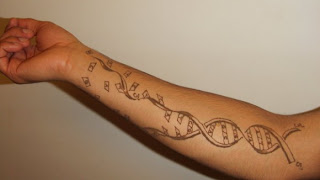
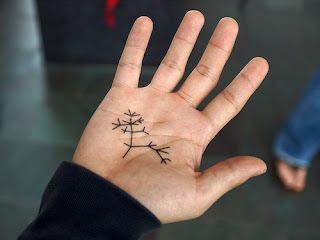
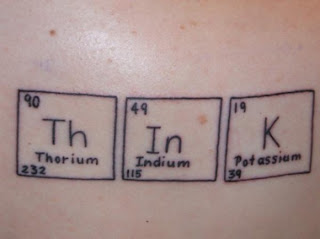
To finish off, I want to share some pictures I found after googling "science tattoo ideas." All photos are taken from http://oddstuffmagazine.com/tattoo-ideas-for-science-lovers.html.


-Matt

Saturday, October 8, 2011

Experiences with Research (Matt Grobis)

Hello all,

When I entered U of I, I knew that biology fascinated me and I wanted to learn as much as I could about it. As a junior in high school, reading Biology by Campbell and Reese changed the way I viewed the world. Our cells have dozens of mechanisms in place to ensure the successful copying of our DNA from one generation to the next, for infinite generations, yet mistakes in copying allow for evolution, for morphological diversification and adaptation to whatever an environment can throw at us. Yet it is also mistakes in copying that can cause cancer, where the stop signs in cells have been cut down and they can't stop dividing. Somewhere in the three trillion cells in our body, one or two have just now mutated into cancer, but thanks to our immune systems the cells quickly get killed. Orders of magnitude away, on the other spectrum of biology, I learned that an organism dying in the forest dissolves back into the component atoms, into life-giving nitrogen and phosphorus that trees readily suck up, into the carbon components that a detritovore then invests into its babies, who are later born as a pseudo-reincarnate of what just died. Animals have elaborate mechanisms to ensure they don't mate with the wrong species; in a world where a predator can snatch your life away at any moment, you can't waste time reproducing with someone who won't let you pass on your genes. The species that weren't careful enough didn't make enough babies and are now extinct. Maybe we can find their fossils and learn about them that way. Yet, for every fossilized species, one million other species were never fossilized because the conditions weren't perfectly aligned to preserve them.

I was hooked. I felt anything that I ever wanted to know about the world, I could find with biology. Yet, I didn't know how to translate this passion into something productive. Sure, I could take biology classes, study, and do well on exams... but I wanted something more, something that extended beyond just me. I wanted to learn as much as I could but then spread it as far as I could. Being a professor sounded perfect: I would wake up every day, eat breakfast, bike past old buildings where famous discoveries had been made, enter my laboratory, and begin working on the questions that teased us today but would be in the textbooks tomorrow (figuratively. It usually takes a decade or two for that to happen!). I would have a super-team of passionate post-docs, graduate students, and undergrads who I'd hand-selected for the motivation to answer the most difficult questions, the keystones to the future, the ones whose answers spawned more questions in the effort to understand how life on Earth works.

And so, I tried getting into research. I made the mistake of e-mailing labs based on the animals they worked with. Mammals sound cool, so neuroscience is great, right? Evo-devo? It took a few tries to realize that it's the questions researchers ask that matter. The organism they study is their means of answering the question. People study evolution in fruit flies instead of primates because it's WAY easier (picture the costs of housing a hundred chimpanzees for the 400 years it would take to do a 10-generation experiment). For me, I realized animal behavior was what really got me. When a fish is born, it has an awful lot to learn in a short amount of time. What can I eat? What can eat me? Where is safe? Who do I mate with and when? Who should I surround myself with? If I can't find food, do I look somewhere else or wait it out? At the risk of anthropomorphizing (attributing human characteristics to a non-human), I liked putting myself in the head of an animal living its normal life, interacting with other animals, learning what plants to eat or to avoid, learning what to do if it gets sick. How does the other 99.9999999% of life on Earth work if you take humans out of the picture? It's beautiful when you think about it.

Finally at the point where I'm applying for graduate schools, I've had to think a lot about what I want to do with my life. Similar to my freshman year, I want to do something more. A lot of people become professors, do their research, and call it a day. I applaud them. But, for me, I feel that I need to spread biology both within and beyond the academic world. Sometimes it amazes me the misconceptions non-biology majors may have about the natural world. And these are college students! Only 1% of the world's population has a college education. There is a lot of knowledge we need to spread. I want to write books for non-scientists one day, telling them exactly why biology is so interesting. They don't need to become researchers hunched over microscopes by the time they reach the back cover, but I want them to think. As the human population continues growing, it becomes increasingly important that we make the correct decisions regarding resource use and coexistence with wildlife. We can start by at least making sure everyone's on the same page.

When I was in Costa Rica last semester, Jordan Karubian, a professor from Tulane, gave a few guest lectures. While his research was very interesting, what really stuck with me was his efforts for outreach in the Chocó, a hyper-diverse tropical ecosystem in Ecuador. Aside from doing research, he fights deforestation by promoting sustainable practices among the local people. Some links to his work:

I want to do something like Dr. Karubian once I'm doing research. Right now, I'm idealistic. I think I can change the world. It sometimes seems so obvious how we can make things better. Yet so many people enter the real world and get bogged down. They get a bad boss, or their roommates never do the dishes, or they encounter a lot of administrative red tape when they want to do something more. They deflate. Someday they look back on college and chuckle at how idealistic they were, when in reality they just didn't know what the real world was like because they didn't have to pay taxes or work forty hours a week yet. Now, sure, some of this may be true. But it's at this point, bogged down and already working hard, that you can change the world. Yes, you can. Anyone can. The people who do are just the ones who believe it.

So, with that in mind... come to the IB Honors reading group on Fridays at the Union! Bring an article and friends, or just come to listen to some cool research. And then go change the world. :-)

-Matt


Tuesday, September 20, 2011

Preparing for the Next Step (Matt Grobis)

Hi all!

With a fresh new class of IBHers learning how to transfer nematodes, reading their first scientific articles, and beginning to truly stretch the science part of their brains, I've been reflecting a lot on the past three years. It's hard to comprehend how much I've changed from a freshman excited but naive about biology to someone who discusses articles every week with friends (Fridays at noon at the Courtyard Cafe! Come!), presented a poster at a conference, is working on a senior thesis, and is preparing for graduate schools. I changed from an English major to someone whose 2011 has entirely consisted of biology. I'm finally reaching the point that when friends ask me random questions about biology, I can come up with an answer that isn't, "Check Wikipedia."

Entering senior year and looking at what's ahead, I feel... prepared. Completely. I'm nervous and occasionally doubt myself, but when I look at what IB Honors has given me, it's like taking a deep breath and closing your eyes for a moment. It's a building block I can push off from. Thinking of the current IBH students and alumni, I'm so inspired to do something with this world. IBHers have gone to receive Marshall scholarships, go to Harvard grad school, research primate conservation, give talks at conferences, found conservation RSOs, work at NASA, double major with engineering/anthropology/humanities, and so much more. I look up to the younger IBHers who start research as sophomores and are already geniuses. And I look up to the members of my class, who despite finishing the IBH core still find time to see each other several times a week.

Without going into too much detail, I'm currently applying for two fairly prestigious scholarships, the type that involve interviews at U of I and plenty of essay drafts. It's stressful, especially when seeing the accomplishments of past scholars. The last U of I student to receive a Gates scholarship (full ride for Cambridge graduate school) had a 4.0 in bio-engineering and seven publications by the time he graduated. Looking at his application, I turned to one of the academic advisors in the National and International Scholars Office and shook my head. "I have no chance," I said. She scolded me and said, "You're just as qualified as he is; you just don't know it yet." Heavy words, for sure. And now, staring at the scribbled comments on the fourth draft of my essays, wondering if they encourage every applicant even if they know they won't make it, wondering if I can do this, wondering if I should get my hopes up, glancing at the clock and thinking of the work for tomorrow, the immediate work versus the shot for my future....

It's stressful stuff, definitely. But at every step there's bits of encouragement. My potential advisor e-mailed me on Thursday and told me to send him my application before I submit it so he can make it better. After several months of revising my Fulbright application, I'm finally done and can help my friends with theirs. Every time I walk into my behavioral ecology class, I get that familiar rush that learning about animal behavior gives me. This feels right. I want to learn everything I can about it!

Outside of grad school applications, I'm considering non-profit conservation work. I did a work exchange for a few days in Costa Rica last semester, where I spent four hours a day composting, hacking Heliconia leaves with a machete, or digging dirt trails in exchange for a place to sleep at night. If a meal or two was thrown into the mix, I would very gladly spend a year or two volunteering with conservation. College is all about preparation for the future. Reaching the future and being able to draw from that preparation is an amazing feeling.

So, current and potential IB Honors students: hang in there! Keep working hard, push through orgo and engineering physics. When you reach the other side, you'll look at what you've gone through and feel amazing. The world is ahead of us... we just have to run through the darkness to claim it.

-Matt

Thursday, July 28, 2011

Animal Behavior Society conference! (Matt Grobis)

Hi all!

So right now I'm at the Animal Behavior Society conference in Indiana. It's been so amazing. A research conference is essentially like college in that there are a few buildings (5 for ABS) with lectures going on concurrently, each 15-30 minutes long. You hop between lectures, choosing the ones you want, and eventually start seeing a lot of the same faces. Each morning and night are plenary talks, which are the biggest names at the conference (ABS paid them to come, for example, as opposed to us paying to be able to present). Their talks are scheduled so they don't interfere with anything and everyone basically goes to them. The plenaries are surprisingly unbelievably friendly... I talked to Hopi Hoekstra from Harvard who has absolutely fascinating research about the genetics of burrowing behavior after talk, for example. My question was pretty small and not that interesting but when I got up to her, she was like "Hi! My name is Hopi" and shook my hand, smiling. I was thinking "oh mah gash of course I know who you are." I asked her the question and she was like "great question! That's such an interesting area of research that we've been thinking about and there's some really cool stuff with etc. etc." and I about melted in pleasure, haha. Another plenary was Shelley Adamo, who looks at immunology (immune system and disease research) and I asked her some questions and she was about bouncing around in enthusiasm and passion. One of the plenaries, though, I tried talking to and she kind of ignored me, which was lame. Oh well.

But basically, you've got a collection of like-minded people who are really passionate about what they're studying. They're also emotionally invested into their work, and so when you're talking with them, you can see how much they love what they're doing, and so all these conversations around you are just filled with excitement and passion, and there's this feeling of communal care and happiness. It's such a great feeling.

There were two poster sessions in the midst of the conference. Relatively big results get talks, smaller results get posters. You hang up your ~1m x 0.75m poster on a board and then you stand next to it while people walk around. My result wasn't that exciting but surprisingly I got like 10-11 people who came by and really wanted to hear about it! There were some stickleback researchers who started debating theory as I was standing there, and started including me and I was kind of blown away and felt dumb for being the one presenting and them being my audience when I had minimal idea what they were talking about, hah! But they were really nice about it and taught me a little. The next day was a bit annoying when, after hanging out with everyone and talking and making connections, they all headed out to the bars while I went back to my room (I turn 21 in a few days), but otherwise it was fine.

So... I'm meeting a lot of people and it's so awesome. I was getting dinner in the cafeteria downstairs with a friend when I saw someone who I'd seen around a few times so I invited her to eat with us. Turns out she's a professor at a university in Liverpool! She was very friendly and we talked about her research while we ate. I've been going up to people whose talks were cool and talking with them afterwards, also. I talked to this girl from Cambridge who had a sweet talk about social conflict in corvids (ravens, crows, rooks, jays) and she recommended I contact this one guy at Cambridge who's looking for grad students! I e-mailed him last night and after nervously waiting for an hour checked my e-mail and saw a response! The response was "Mail delivery failure, destination not reached." Ahhhhhhh! haha. So, I searched for a while and found another address and tried that one. Today, I saw I got a response from him and he was really open to the idea and wants me to send him a proposal for a potential PhD project, which he said we can then work on together to make it feasible and work out! Woooow. I'm so excited. Getting into Cambridge would be insanely hard, though, and even if I get in, I can't work in a lab unless I also get outside funding, so I better get on that. But outside of Cambridge, I found a lady doing social work with corvids at University of Washington near Seattle, and she's looking for grad students, so I introduced myself last night and we talked for half an hour. I don't really want to go to UWash so I wasn't really nervous while talking to her, but there came a moment in the conversation when I was like "holy crap, I could be talking to my future advisor right now" and it made me a lot more serious in what I was talking about. Cool stuff! Options are nice.

Anyway, I'm going to grab lunch now. There's some more cool talks coming up and the plenary for tonight actually works with corvids, so I'm going to try to make a good impression when I ask him questions after his talk. I've had trouble sleeping the first few nights because i've been so excited about meeting all these people and being surrounded by such nerdiness, but I'm starting to get really tired... I'm basically on from 8am until midnight every day! The conference ends tomorrow at lunch and I'll be a bit disappointed but relieved it's over (no more chances to make a fool of myself, lol).

Take care,
-Matt

Monday, May 16, 2011

Culture Shock (Matt Grobis)

I expected something akin to culture shock in January when I began my semester abroad in Costa Rica. The program was through the Organization for Tropical Studies and focused on tropical biology and conservation. We spent three and a half months at six research stations, frequently with no internet or hot water, doing fieldwork that required tall rubber boots to protect from snakes. We met farmers who work hard to produce goods like coffee or sugarcane and can only hope for favorable weather to make a profit that year. We got caught in the rain doing field research, watched sunsets on the ocean, spent hours identifying insects under microscopes and plants under hand lenses, picked cocoa fruit that would make the chocolate we later ate, and slept on long bus rides after nights full of dancing. Over those three and a half months, the twenty-eight of us were never apart for longer than a few hours; during our homestays in San José, the first thing we did with our free time was pile into a bus headed for San María de Dota to visit one of our Tico friends. The most privacy I had was when I showered; at all other times, there were six, ten people in a room with me.

I returned to the U.S. after a full day of flying, exhausted but happy to see my dad who picked me up from the airport. Driving home, I expected to feel something – joy, sadness, excitement – but I was too tired to react to the sights of the roads close to my home. My dog would have none of it, happily barking and whining when she saw me, running in with her eyes nearly shut from sleepiness, her tail hitting against kitchen cupboards. I closed the door to my room later and thought then I would feel something, but still, nothing. I smiled a little at the sound of frogs in the pond behind my house and then fell asleep.

The next day, my dad and I went to the mall to buy a cell phone for me because mine had broken right before Costa Rica. I immediately noticed how huge the mall was – three floors – and filled with anything you could want (except books, for some reason). There was even stuff you couldn’t possibly want but advertisements were everywhere, convincing you that you did. While I was buying the phone, the woman working there tried pushing all these extra accessories, most of which I didn’t need. Those I did, I noticed, were plastic-wrapped in a plastic box, handed to me in a plastic bag. On the drive back, I looked out the window at long empty fields devoid of trees next to the four-lane highway, the trees cut down to make room for more houses or stores. Today, I was walking my dog and stopped for the first time to look at one of the few trees on the walk. I saw simple opposite leaves with pinnate venation, as well as big interpetiolar stipules, and the thought that this far away from Costa Rica what I’d learned was still applicable made me smile. I passed big houses with huge lawns; meeting no one on my walk but being passed by numerous people in cars talking on their phones.

And now, finally back home after a long semester, I’ve finished most of the things I wanted to do when I got home. I’m sitting in a quiet room, listening to the frogs outside, looking at pictures of my last few nights in Costa Rica. I’m thinking about how different a lifestyle it was; today I asked my dad to buy vegetarian patties when he left for the supermarket. He came back with chicken patties and, when I asked him about it, gave me a look that seemed to say, “Why would anyone want vegetarian chicken?” My apple cores and banana peels are going into a garbage can heading for a landfill. There are so many bottles of water in my kitchen. My shower pumps at least twice as much water as anything I’d experienced the last four months. I feel I can’t live like I promised myself in Costa Rica, when I could walk through a rainforest that wasn’t yet cut down or admire an animal yet unaffected by climate change.

I’ll return to Costa Rica, undoubtedly, but until then, I have to find a way to merge these two lifestyles. Looking at the friendship bracelet Chesca made for me, I know I will see everyone again eventually. I miss you guys. See you soon.
-Matt

Tuesday, August 17, 2010

Enjoying Summer (Matt Grobis)

Hi all,

It's definitely nice being on this side of calc III... I finished summer classes, which included calc 3 and creative writing, last week and have finally had what I could call a "real" summer vacation. Calc 3 was a pretty nasty hurdle and I actually questioned IB Honors towards the end of the class... if I wanted to go to a good graduate school, wouldn't a better GPA help more than a mediocre grade in advanced calculus? Why was I stressing myself out learning about Green's Theorem, triple integrals, and partial derivative chain rules if I wanted to work with conservation in the future? In theory, taking all these hard classes would make us smarter but in reality, wasn't it just another hoop to jump through?

Having finished Calc 3, I'm a lot more ambivalent about its inclusion in the IBH curriculum. Sure, it was stressful, but education is about broadening your horizons and better understanding the world, and learning all about calculations with multiple variables does that... right? At any rate, maybe I'll be using something similar in the future. I was dead-set on being an English major from when I was nine until senior year in high school, and now I'm on the pre-graduate path for science. If I had never taken AP Bio in high school, there's a good chance I wouldn't have discovered that I love biology. Take a chance, then... maybe you'll find something you wouldn't have otherwise.

I do have one suggestion for the IBH curriculum, though. Instead of automatically gearing towards receiving a chemistry minor, it would be cool if students could have a choice between two or three different "minor concentrations" they could choose. For example, I find astrobiology fascinating. Having the opportunity to IBH minor in physics or astronomy, I may have preferred choosing that over chemistry. Chemistry is probably the most practical and relevant to biology, but if IBH stresses that it prepares students for any field (according to the program description), wouldn't it be cool if students had a little more say in how they handled this education given to them? Just a thought.

My dog is whining at me so I'm going to walk her now. See you all in a week!
-Matt

Monday, May 17, 2010

Now that it's over... (Matt Grobis)

Now what? haha. Summer vacation is lovely... get up when you want, sleep how much you want, no work, just fun... interestingly enough, I'm glad this will only last about a week. It's nice to get out the Xbox and play games I haven't played in months, sleep 9-10 hours a day, and not have the stress of always having to do something on my mind, but I can't help but feel like I should be doing something... more. I suppose in the end it really is all about balance; in the midst of paper-writing and studying for finals last week, I gladly welcomed days with absolutely nothing on the planner. Now, though, once I've blown up a good share of mutated monsters' heads in Fallout 3 I can't help but desire some sort of structure to my days.

Like I said, though, things are good. I'm leaving for South Africa this Thursday and I'll be there for three weeks. It's a program through U of I about wildlife conservation and management along with learning about the various ecosystems in the region. We'll mainly be in national parks and the last six days or so will be spent hiking and camping... very excited for that. Apparently the trip starts with looking at animals through bars (in an animal rescue center, for example), then looking at them through the Jeep windows, and then seeing them while actually walking around. There's something called the "titanic seat" on the Jeep, which is a seat at the very front of the car, actually on top of the engine area. All of us on the trip (~10) are fortunate enough to get a turn on that seat (:-\)! When we're driving around and passing leopards and elephants, I wouldn't be surprised to feel like I was about to get mauled at any moment. No casualties so far, though, they've said. I won't be taking antimalarial medication because we're going during Africa's winter and mosquitoes aren't active at this time. I did get a hepatitis A shot and am taking an oral typhoid fever vaccine from McKinley, however.

Speaking of Africa's winter, I feel compelled to share something. When I tell people I'm packing for my trip to Africa, they're usually like "oh, so you're bringing lots of shirts and shorts and sun screen, right?" Then I tell them we'll be there during Africa's winter and they say, "oh, so you're bringing lots of sweatshirts and pants and stuff, right?" Turns out that both sun screen and a heavy winter coat are on the packing list. Winter in Africa means the temperature is a little below freezing at night and then over 100F during the day. Yeah. That's insane. Layers, they keep reminding us. I'm really curious about the resilience and determination of life in this climate at such an intense temperature range. These parts of Africa are extremely diverse despite the seemingly unfavorable conditions. If the conditions are predictable and regular, though, it makes sense that something out there found a way to survive in them.

When I get back, I've got a few days to myself and then I'm off to U of I again to take some classes and continue research in my lab. Some of my IBH friends will be around so I'm looking forward to hanging out with them in a non-stressed setting :-) It's looking to be a good summer.

Finally getting some sleep and about to go play some more Xbox (while I still can!),
-Matt

Monday, April 19, 2010

Keeping a Good Lab Journal (Matt Grobis)

I feel like I learned a lesson today that IBH has been trying to drill into our heads from day one.

I came into the Sears lab today with instructions to set up some opossum matings + tapes and then prepare some primers for PCR. The opossum matings went fine; I've been doing this every Monday since the start of the semester and lately it's been going really well. I got back upstairs, hung up the lab coat, put away the keys and i-card (I'm still not authorized downstairs) and got to my lab bench and...

Now what? I stared at the two boxes of primers for a moment before rifling through my bag to look at the notes I had taken from two weeks ago, when the P.I. (Dr. Sears, the head of the lab) and I did this for the first time. They were brief and scattered but had immense holes in them - did I add the ddH2O directly to the capsules, did I centrifuge first (and for how long?) and then add the water, did I add 10x the mass of the sample as uL or nL, was DEPC H2O ok if ddH2O wasn't available? I actually got scared, holding hundreds (thousands?) of dollars of technology in my hands and not knowing what to do. Dr. Sears was gone and the other students in the lab were busy doing their own projects. I've felt guilty making them take time out of their day to bring me up to speed, the new kid who's just a weight on the lab until he starts pulling his own weight. I looked at my notes again but didn't know where to start.

Fortunately, one of the other members of the lab saw me struggling and came over to help. She gave me her notes (much better ones, I might add) and gave me some advice on what to do before getting back to her work. After a question or two for clarification, I started prepping the samples and in a matter of minutes messed up because I hadn't read my notes (and hers) carefully enough. This happened again twenty minutes later, probably because I was a little tired as well (sorry Dr. Cheeseman, I know I know).

When I finally put the solutions into the PCR machine and hit "Start," I knew that I needed to really get serious about the notes I took during lab. In IB 270 and 271, it's important that we take notes so that we can know what we did when it comes time to write the lab report or (in 271) do the experiment again. But in those cases, I was with other students, working together in something that at most will cost me a few points in the long run with the semester. Now I was in the same situtation but with the trust of a professor, where my work is really an extension of her work, her career. I was handed something worth enough money that messing up would make me look pretty bad. And I almost couldn't do it.

Dr. Cheeseman keeps telling us that everything in IB Honors happens for a reason (wow, replace "IB Honors" with "life" and you have something philosophical going on). Jokes aside, I understand what he means now... the lab journals, the sleep. It's easy to brush the advice aside when we're working late into the night on something we put off, but in reality the man's right. I don't want what happened today to happen again.

Off to Walgreens to buy a fresh lab notebook,
-Matt

Sunday, April 11, 2010

IBH Barbeque! (Matt Grobis)

Hello all!

So finally an entry that isn't about how much work we've had or how stressed I am. Today was the IBH barbeque that Dr. Cheeseman promised at the start of the year (don't worry - the reason it was today was because we forgot for a few months :-P). I walked to ISR to meet Darcy and saw Jess on the way. We walked together and met with three juniors in IBH when we got close. A few minutes later, we entered Dr. Cheeseman's back yard. It was awesome. His backyard has a big variety of different plants and the food was great. I've never been to a barbeque with such a diversity of food. Most of it was stuff I had never had, either, like Greek spinach pie or this type of plant that tastes like licorice. We had delicious liquid nitrogen ice cream, too, which was a necessity at such a science-y get-together. Everything was great... it was beautiful out, Dr. Cheeseman's wife was really nice, and everyone was just in a great mood.

It was really nice hanging out with these people I've stressed out with and worked all hours of the day with. We all swapped nerdy bio jokes and talked about our summer plans, what we were doing later that day, and just about anything really. I can tell that these are folks I'll be talking to years from now... Cally bought pizza Thursday evening / Friday morning and I couldn't break a $5 so I told her I'd pay for the IBH get-together in 20 years. We pinky-swore on it so I guess it's undeniably happening. I'm looking forward to saying "oh yeah, I knew so and so. We were in IBH together." Some day, some day...

Here's to more events like these :-)

-Matt

Friday, April 2, 2010

April's Here! (Matt Grobis)

Hi!

Phew, what a hard week... and right after the typical "tough week before spring break," too. The week before spring break, we had two lab reports due in IB 271 in addition to a lab report due in CHEM 237. I got some last-minute Sears lab work and had stuff in my other classes, too, so it was a loooong week. I slept like ten hours a day during break just catching up :-) (it was glorious). We came back to an open-note take-home exam that I figured wouldn't be too bad because I had studied over break. Yeah right! Every time I underestimate IBH I generally get my butt kicked... that exam took a cumulative nine hours. When that was finally finished, it was 5:00am Wednesday morning and I scraped together a few hours of sleep before my 10am.

Then in bio lab, while most of us are brain-dead and exhausted, Dr. Cheeseman announces that in this lab, we have to design our own procedure to answer a question on differential GAPDH activity in green and not-green sections of leaves. We knew we'd be re-doing the first experiment of the semester as a way to check how well we took notes in our lab journals, but the "design your own procedure" made me want to put my head in my hands and sleep/cry/etc. It was tough. But, my group collaborated, we pushed each other, and we got it done. Then that night I slaved at a chem lab report and designing a procedure for a final project synthesis. I was so tired. But I got through it.

The week's over and I'm looking forward to some beautiful sleep, watching season 2 LOST (I'm getting caught up!), writing creatively a bit, and just relaxing. Oh yeah, and doing plenty of homework of course.

On a non-homework-related note, I'm pretty happy with stuff. Classes are interesting, warm weather is lovely, karate yesterday was really fun, I have a sub-lease for this summer pretty much set up, I won $1100 scholarship for my 3-week study abroad in Africa this summer, things are good with the girlfriend... it's all good. All the work may be tough, but I'm learning a lot and feel I'm getting a lot smarter. With sophomore year drawing to a close, I'm comparing myself to who I was in that car going home at the end of freshman year and I wonder how I could say I knew much about biology at all... especially the experiment side of it. Yay IBH. Well now I'm really tired so I'm going to lie down... then Chipotle at 3:00 with the other karate instructors. Can't wait!

-Matt

Saturday, February 27, 2010

New IBH Kids Coming In (Matt Grobis)

Hello!

So interviews for IB Honors are this week and I'm excited to see some fresh faces excited about biology :-) . This semester's been going well; I'm working in the Sears research lab and taking IBH and orgo labs so pretty much any day of the week 1-5pm I'm in some lab, haha. It's good though. At yesterday's lab meeting, the post-doc Lisa talked about this really interesting project idea she has regarding the evolution of mammalian hearing. Depending on the type of work she'd be doing, there's a chance I'll be joining her soon. I'm really excited... besides that, though, I'm learning lab techniques like in-situ hybridizations to analyze the opossum embryos and I'm learning to manage the opossum colony in the basement. That's one on the right if you're curious.

The longer I'm in IBH, the more I love it. The small class size can't be stressed enough. It's amazing. U of I is a huge place and it's hard to feel connected to the people around you when you see them for one semester in one of your classes and then never see them again. In IB Honors, though, I see the same people MWF every week for hours, and the core is extensive enough that I see them in pretty much all my other classes too. It makes U of I feel much smaller when you're working on that tough orgo problem set with your lab partners or comparing labs that look interesting or just seeing these people on the Quad. You can't help but become close because of all the time you end up spending with them. And everyone in IBH is so interesting... you don't leap into this major without loving biology (hopefully!), and so everyone has something interesting to add to a conversation. During last Wednesday's lab, some IBHers and I got into a discussion on the global warming "debate" (more so why some people - particularly those receiving funding from companies who would suffer from stricter emissions regulations - are taking such measures to deny global warming), possible evolutionary explanations for a belief in God, and even just our favorite books. For a school as enormous as U of I, this keeps me sane.

Well, I better get going. And to any students interested in IBH that are reading this before next week's interviews: good luck! Just relax and let your love for biology shine through.

-Matt

Saturday, November 28, 2009

The Semester's Almost Over! (Matt Grobis)

Hello!

With Thanksgiving over and preparations being made to return to U of I tomorrow, I'm realizing that there's a week and a half of classes left. Then finals and... it's over. Whoa, hold on a second. I remember several points during the semester when I'd look at an Allenotes in my dorm (Allen Hall) and see that it was week 8, or week 10. The semester was one enormously long stretch until about halfway through, and then the next few weeks flew by. Crazy...

This semester has changed me, I think. I feel a little burned out... I actually laughed a few days ago when I asked myself if I really want to go to graduate school. What would the other option be? Stay home and play video games? Try to make a rock band and play drums for a living? Sure, those are sources of immediate gratification, but what's down the line? Deprived of biology long enough, I'm sure I'd start itching to learn more about how the world works. This all reminds me of that concept from introductory psychology... it's like, people have "lists" of desired activities, and things that are normally low on the list can actually move up if one doesn't do them frequently. The opposite thing can happen for things that one does very frequently. People take for granted their health until it's jeopardized... then, it's the most important thing in the world to them.

Anyway, this is a tremendous deviation from the point of this post. I feel burnt out because I've tried so hard and met such resistance, especially from organic chemistry... I'll be glad when it's over. And I'll be glad when this semester is over, but not because I'll be done with my classes. I feel that I have learned so much this fall, maybe more so than the entire last year. Finishing this semester will put a cap on everything that I've done so far and let me finally get closure on the last few months. IB Honors has been intense but it's been a flood of information and experiences that I want and that have helped me understand the world.

It was nice to return home and be able to put the books aside and do whatever I wanted with no obligations for a few days. After a while, though, I started getting that familiar uncomfortable feeling like I should be doing something worthwhile. This, I feel, is the reason I want to go to graduate school. It's easy to get lost in the work, sleep deprivation, and occasional frustration. The whole point of why one is doing something can be hard to hold onto. I want to pave the way into unfamiliar territory, into concepts that are still unclear and the textbooks avoid. I want to do something that others will read about and say, "wow." When I was in high school, in my final reflective paper in English I wrote that I wanted to change the world. Coming to college, I see that changing the world is going to be a bit harder than I anticipated. But give me time.

-Matt

Saturday, October 24, 2009

Late into October (Matt Grobis)

Hello all!

I've gone home for the weekend and have finally found the time to write something here. This semester's been hard, much harder than the other two here. Science and math classes can be really time-intensive, so even if the material itself isn't hard, if it takes a few hours to do it, those few hours are going to be bumping shoulders with the time it takes to finish other homework. Result: very late nights if you don't time manage.

For example, our first lab report was due in IB 270. The lab, analyzing the relationship between two phenotypes in C. elegans, seemed like it would have a straightforward and simple lab report. My group took copious notes in our lab notebooks and the lab report rubric didn't seem too bad. BUT: it took time. A lot of it. I realized this at 4am Friday morning, when I took a quick break from writing to finish (ok... start) my orgo problem set due in five hours. How'd this happen?!

At no point that week had I purposely put off doing homework. I was busy doing other work, but the work was always just what was due the next day. There's this thing called "planning ahead" that you need to learn when you come to college, and if you don't do that, sleep deprivation awaits if you want to get any sort of decent grades.

I'm not trying to scare anybody thinking about IB Honors. Read the rest of this post if you want to get excited about it, because I'm really happy here. It's just a lot of work. You need to be really driven to get through math through calc III and organic chemistry in addition to tough bio classes. Physics, biochem, and statistics are probably going to be tough too. But the thing is: everyone in IBH is going through this. That night I was up late writing the lab report, I joked around a lot with the other students there and we had Jimmy John's together, making light of the situation. We're all stressed. We're all trying our best. You really bond after something like that.

Academics aside, let's get to the dorky intellectual stuff... I'm so happy! I'm realizing that one of my favorite parts of IB 270 is reading scientific articles every week. This week's article was "Massive Horizontal Gene Transfer in Bdelloid Rotifers," by some people at Harvard and the Marine Bio Lab in Woods Hole, MA. Horizontal gene transfer (HGT) is where a change in the genome occurs during an organism's lifetime, as opposed to vertical gene transfer, where two parents produce an offspring with a different genome. HGT is very common in bacteria but very rare in animals. In this one type of animal, the rotifer, though, the team found dozens of genes from bacteria, plants, and fungi. How could this have possibly happened? The article goes into detail about where they found the genes and how they could have gotten there; they use the same BLAST procedure that my lab group did to compare genes in different species (more on that later!) and analyzed where in the genome these foreign genes were.

I absolutely love reading stuff like this because it's so new that it's not even in the textbooks yet. I've realized that a lot of textbooks can be thorough but not very deep. They can cover a lot of material at a certain level of depth but they have to compromise that depth to cover everything they need to cover. A research article, on the other hand, is the equivalent of a paragraph of the textbook gone into incredible detail; basically, that paragraph is expanded into a few pages. Very cool.

So, back to the BLAST thing I mentioned. BLAST is a button you press on a website after specifying a nucleotide/protein/etc. sequence that you want to find similarities for. Normally this sequence you have corresponds to something in an organism, and you're trying to find related genes in other organisms. My lab group did this for our Discovery Project (I think I talk about the Discovery Project in detail two posts ago; check it out). We wanted to analyze olfaction and chemotaxis in C. elegans: ideally, knocking out a gene related to olfaction would result in a loss of chemotaxis. We found a gene in mice that, when knocked out, resulted in impaired olfaction. We BLASTed that gene and lo and behold, a near identical gene is present in C. elegans! We looked into a few articles on it, and nobody's done our exact experiment yet. Our semester project has been formed!

Anyway, on to other subjects. Orgo and calculus are hard but I'm managing. In my PSYC 433 class, we watched this amazing National Geographic special on Robert Sapolsky, a neurobiologist at Stanford who works with baboons in Kenya. In the video, a comparison was made between his findings of stress levels in the baboons and the results of a correlational study conducted in England on stress levels in workers in particular businesses. Baboons make a good comparison because they spend only 3 hours a day on food; the other 9 are entirely social behavior. Baboon groups have strong hierarchies, and the study found that as you descend from the top, your stress levels keep increasing. Interestingly, the same result was found with the people working in the hierarchial businesses in England. The special then went into detail on the health effects of stress, how to manage it, why zebras don't get ulcers (that's the name, actually, of one of Sapolsky's books), and more, all intertwined with beautiful views of the savannah. Awesome.

I hope this thing hasn't dragged on too long. I'm going to eat some cereal and get started on orgo reading, which never ends... but at least it's good to be home :-)

-Matt