
Sunday, June 3, 2012
Fulbright (Matt Grobis)
Hi all!
To those who haven’t heard of the Fulbright grant, a Fulbright is funding to do research or teach English for one year in a foreign country. Because everything is paid for, you can imagine it’s fairly competitive. (For more info, go to http://us.fulbrightonline.org)
I was lucky enough to be selected for one. Next year, I’ll be carrying out a Fulbright research grant at the Max Planck Institute for Ornithology, in Germany, studying the intersection of great tit personality and social behavior. One of the projects I’m looking forward to working on is examining how birds of different degrees of boldness rely on conspecifics to find food. One application of this is ensuring beneficial human-animal interactions; understanding how knowledge about foraging sites travels through groups can help us predict native bird populations’ responses to anthropogenic habitat change, for example. I will be working with Dr. Niels Dingemanse, a researcher at the MPIO and also a professor at the Ludwig Maximilian University, in Munich. The Institute is located a forty-minute train ride south of Munich and I’m very excited to explore the city and learn about German culture. Hopefully a year of German at U of I is enough to let me get by, though I’ll be keeping a dictionary close by!
I first learned of the Fulbright a year ago, when I was looking at graduate schools. I found a girl doing really cool research on tiger-human conflict in India and e-mailed her, asking if she had any advice for how she got to where she was. In her very helpful response, she mentioned her Fulbright year in India and how it’d helped her decide what to do for a PhD. Shortly afterwards, I met with the head of my research lab, Dr. Alison Bell, and asked for her help finding someone with whom I could do research abroad. Dr. Dingemanse’s research interested me the most, and after an e-mail that took me a few tries to write, I received a good response! We e-mailed back and forth over project ideas and came up with a tentative project. Meanwhile, I was working on my Fulbright application with the help of the National and International Scholarships Office at U of I (http://topscholars.illinois.edu). I’m very thankful to Laura Hastings and David Schug, who helped me through every step of my application. I would recommend to anyone even considering pursuing the Fulbright to fill out an application; the process of organizing your life up to this point and deciding what direction you want to go with it now was immensely helpful.
I was on the waitlist for ten weeks, so I feel very, very fortunate to be in this position. My advice to anyone considering applying for a Fulbright comes in four parts. First, start early! It’s crazy to think I started working on my Fulbright application over a year before I heard the final result. First drafts of essays are always terrible and it takes everyone a while to find an angle to their application. Keep pushing. Have friends, family, and professors give you feedback, and you’ll end with something you’re happy with. Second, find very good reasons why your Fulbright has to be in the country you chose. If you want to teach English in Ecuador, why not Colombia, Peru, Chile, Panama, or Spain? How is a neuroscience lab in Switzerland better than MIT or Cambridge? Outside of research, what can you offer Madagascar that you couldn’t to South Africa or Ghana? Third, be as specific as possible whenever possible. Anyone can write “I plan to volunteer while I’m in Vietnam” and get away with it. It looks much, much better to write “I have contacted this non-profit in the nearby town, which is ten minutes away by bike, and the head of the program, Mrs. such and such, has agreed that I can help on these projects.” Fourth, throughout the whole process, be humble and thankful. Your application needs to make you look awesome, true, but your success highly depends on the help of a lot of people. Say thanks to your letter of recommendation writers. Understand that the person you contact to do research with is taking a chance by responding to an e-mail from someone he or she has never met.
If you apply and you’re lucky, you will get to spend a year in another country learning from others and about yourself. But even if you don’t receive a grant, you will still learn from the experience and be better-prepared for selling yourself to graduate schools or potential employers. I wish you the best of luck! Send your applications to the National and International Scholarships Office before the July 1 priority deadline (if you can!), and please message me if you’d like advice or another pair of eyes on your essays.
-Matt


Sunday, May 13, 2012
Top Ten Ways NOT to get into Graduate School
So it is that time of the year again: IBH students are running off to graduate schools, medical schools (or other professional schools), and their first “real-world” jobs. Some of you are probably wondering how to get into the graduate school of your dreams. While I am definitely no authority in that area and there are numerous how-to resources available on the internet, I thought I would write up an article on the ten best ways NOT to get into graduate school. So here it goes:
10. Not listening to your closest friends.
Sure, they don’t know how you feel, but that might be a good thing since they CAN SEE the amount of stress you’re going through. While this might be hard to believe, from your friends’ perspectives, you started off looking like Thomas the Train…


9. Not listening to your academic advisor.
Not listening to your friends is one thing, but it takes a special blend of arrogance and a naïve-nature to not heed your academic advisor’s warnings. Chances are that you’re not the first overly-ambitious student to walk into his/her office so this is a time to listen! Yes, taking an x amount of credit hours over 18 might be okay, but you should listen to what taking those extra x hours means. Also if your advisors look like this…

…or this…

…then you should really know to listen!
8. Listening to your first immigrant or non-college educated parents a bit too much.
Ah yes, disregarding the advice of the people who interact with you on a daily basis and your academic advisor is totally logical when you take up the advice of your parents who never went through the American university system themselves. Their anecdotal stories of how Susie Q. was able to go through college while taking 22 credit hours each semester, completing multiple majors, being involved in no less than five clubs (with leadership positions, of course), having a full-time job, doing research, maintaining a 4.0 gpa, and getting college totally paid for sounds like a lot of bull crap, but you’ll buy into it anyway and try to be Susie Q. (who is probably the collective sum of all the positives of the children from your parents’ coworkers). Point is, there is no Susie Q., and even if there was, you’re not Susie Q. So when the going gets though, it’s time to listen to your friends and advisors.

7. Being pre-occupied with funding college.
College is expensive, but it is also one of the most important investments you’ll (probably) ever make. While it would be nice to have college paid for, spending hours completing scholarship applications for the “write-10-pages-describing-your-most-whatever-moment-in-your-life” to try to earn an insignificant amount of $100 is probably not the best use of your time. Focusing on keeping your GPA up will bring in greater awards anyway (by allowing you to apply for scholarships that actually take a significant amount of your load) and is a much better use of your time. In the end, if you have to take up a lot of loans, just remember that your future job will help pay all those off.

6. Not finishing what you started isa terrible idea! actually totally okay.
Your first priority as a college student is to finish college well. All other priorities come secondary. Have to choose between studying for orgo or helping with finishing decorating for the program you suggested at your residence hall? Choose studying. Especially since when you're done studying for your classes, you should start studying for your GREs or MCAT (or whatever). Don’t feel guilty for not helping finish a project that a group of other people are equally excited for, but don't show up to help for. The same goes for all other activities (i.e. clubs, meetings, job, etc...).

5. Assuming higher level courses will become relatively easier compared to your core courses.
I have heard over and over again that higher level courses are relatively easier compared to your core courses and its true to some degree, but don’t let that get into your head. They only appear easier because of the hard work ethic you’ve built in the first couple years (the curve helps too). I don't know what this is doing here at number 5...this should've been number 10. Anyway, point is, focus on your current courses with the same level you always have (unless your focus level was low to begin with). If you have to, take another semester or two to finish your degree.

4. Conducting your research for your senior thesis with very limited adviser interaction (whether that adviser be a professor or a graduate student).
If there is one thing I could change about my undergraduate research, it would be to work under more guidance. Although the initial amount of control I had over the project was very appealing, there was a lot of time spent reinventing the wheel as each mistake made me realize that it could have been prevented with just a little bit more knowledge or experience. You couple that with a project that is relatively unfunded, you will not only be searching for money to pay for school, but for money to pay for your undergraduate research.


3. Not budgeting your time correctly.
The current state and national monetary budget crises should give you a glimpse of the disaster of poor budgeting skills.

Pretty soon, you’ll start “borrowing” time from other projects and activities and to “pay back” for that “borrowed” time, you’ll start “borrowing” from even more places. The path is totally unsustainable. There aren’t enough seconds in a day to fuel all your ambitions just as there isn’t enough money to fund every single government program or misadventure. In short, if you don't have a Time-Turner like Hermione or can't steal more time like that Timberlake fellow, then you're better off budgeting what you have and not wasting it.


2. Trying to prove something.
Sometimes when I mess up, I try to take on even more things and be successful to lessen that mess-up and make it seem irrelevant. Yeah, don’t do that. This is an example of another unsustainable strategy. If you keep messing up and keep raising the bar higher, you will never succeed. If you’re messing up, the universe is telling you don’t do it. You’re not up to the challenge and creating hard, unreachable goals will only de-motivate you.

1. Not sleeping.
My mom used to tell me, “You’re six years old, not five. Act like it.”
Well, in this case, I’ll just say: You’re a human being, not a computer. Act like it.

10. Not listening to your closest friends.
Sure, they don’t know how you feel, but that might be a good thing since they CAN SEE the amount of stress you’re going through. While this might be hard to believe, from your friends’ perspectives, you started off looking like Thomas the Train…

"I think I can, I think I can."
…but by mid-semester, ending up looking like a train wreck.

"Yo, what's up guys? No, I'm fine, why?"
9. Not listening to your academic advisor.
Not listening to your friends is one thing, but it takes a special blend of arrogance and a naïve-nature to not heed your academic advisor’s warnings. Chances are that you’re not the first overly-ambitious student to walk into his/her office so this is a time to listen! Yes, taking an x amount of credit hours over 18 might be okay, but you should listen to what taking those extra x hours means. Also if your advisors look like this…
…or this…

…then you should really know to listen!
8. Listening to your first immigrant or non-college educated parents a bit too much.
Ah yes, disregarding the advice of the people who interact with you on a daily basis and your academic advisor is totally logical when you take up the advice of your parents who never went through the American university system themselves. Their anecdotal stories of how Susie Q. was able to go through college while taking 22 credit hours each semester, completing multiple majors, being involved in no less than five clubs (with leadership positions, of course), having a full-time job, doing research, maintaining a 4.0 gpa, and getting college totally paid for sounds like a lot of bull crap, but you’ll buy into it anyway and try to be Susie Q. (who is probably the collective sum of all the positives of the children from your parents’ coworkers). Point is, there is no Susie Q., and even if there was, you’re not Susie Q. So when the going gets though, it’s time to listen to your friends and advisors.

Susie Q.
7. Being pre-occupied with funding college.
College is expensive, but it is also one of the most important investments you’ll (probably) ever make. While it would be nice to have college paid for, spending hours completing scholarship applications for the “write-10-pages-describing-your-most-whatever-moment-in-your-life” to try to earn an insignificant amount of $100 is probably not the best use of your time. Focusing on keeping your GPA up will bring in greater awards anyway (by allowing you to apply for scholarships that actually take a significant amount of your load) and is a much better use of your time. In the end, if you have to take up a lot of loans, just remember that your future job will help pay all those off.

6. Not finishing what you started is
Your first priority as a college student is to finish college well. All other priorities come secondary. Have to choose between studying for orgo or helping with finishing decorating for the program you suggested at your residence hall? Choose studying. Especially since when you're done studying for your classes, you should start studying for your GREs or MCAT (or whatever). Don’t feel guilty for not helping finish a project that a group of other people are equally excited for, but don't show up to help for. The same goes for all other activities (i.e. clubs, meetings, job, etc...).

This is totally okay.
5. Assuming higher level courses will become relatively easier compared to your core courses.
I have heard over and over again that higher level courses are relatively easier compared to your core courses and its true to some degree, but don’t let that get into your head. They only appear easier because of the hard work ethic you’ve built in the first couple years (the curve helps too). I don't know what this is doing here at number 5...this should've been number 10. Anyway, point is, focus on your current courses with the same level you always have (unless your focus level was low to begin with). If you have to, take another semester or two to finish your degree.

4. Conducting your research for your senior thesis with very limited adviser interaction (whether that adviser be a professor or a graduate student).
If there is one thing I could change about my undergraduate research, it would be to work under more guidance. Although the initial amount of control I had over the project was very appealing, there was a lot of time spent reinventing the wheel as each mistake made me realize that it could have been prevented with just a little bit more knowledge or experience. You couple that with a project that is relatively unfunded, you will not only be searching for money to pay for school, but for money to pay for your undergraduate research.

The ideal undergrad research experience. Thesis entitled "The variation in madreporite size in Pisaster brevispinus at Hanalei Bay in Kauai, Hawaii."

The less ideal undergrad research experience. Thesis entitled "The variation in asinine responses to fire by undergraduate Homo sapiens at John G. Smithe Hall in Champagne, Illinois."
The current state and national monetary budget crises should give you a glimpse of the disaster of poor budgeting skills.

Pretty soon, you’ll start “borrowing” time from other projects and activities and to “pay back” for that “borrowed” time, you’ll start “borrowing” from even more places. The path is totally unsustainable. There aren’t enough seconds in a day to fuel all your ambitions just as there isn’t enough money to fund every single government program or misadventure. In short, if you don't have a Time-Turner like Hermione or can't steal more time like that Timberlake fellow, then you're better off budgeting what you have and not wasting it.


Actually, with only 25 seconds left, Timberlake might not have been the best example to give here.
Sometimes when I mess up, I try to take on even more things and be successful to lessen that mess-up and make it seem irrelevant. Yeah, don’t do that. This is an example of another unsustainable strategy. If you keep messing up and keep raising the bar higher, you will never succeed. If you’re messing up, the universe is telling you don’t do it. You’re not up to the challenge and creating hard, unreachable goals will only de-motivate you.

1. Not sleeping.
My mom used to tell me, “You’re six years old, not five. Act like it.”
Well, in this case, I’ll just say: You’re a human being, not a computer. Act like it.

Remember that ultimately you're responsible for you. Hope some of you find this helpful and good luck on applying to schools and jobs!!
Friday, April 6, 2012
Biologi i Uppsala! Detta är inte Amerika… (Abigail)
(Biology in Uppsala! This is not America… )
Back home, I often feel like I am being pulled in at least
10 different directions. So being here and being able to focus on one subject
has been nothing short of amazing. I have begun to completely question the
non-Swedish way of doing things. How much can you really get out of a class
when you are busy worrying about your other 3 exams and that paper you have to
write? It just makes more sense to focus all your energy on one task at a time.


And while the masters is becoming optional in America, in most European education systems, the masters is a necessary step towards getting a phD. Unfortunately for us, doing a masters in Sweden is no longer free for Americans!
Hej IBHers! As many already know, I am currently doing a
semester abroad at Uppsala University in Sweden. Now that I have been here for over
2 months (wow time really flies) I thought it was time to share my experiences
with my fellow IBHers.
To sum up my experience thus far: studying biology in Uppsala has been amazing! For the first 10 weeks of the semester, I took a master’s level course in Behavioural Ecology. As of now, I am doing a research internship in environmental toxicology and studying basic Swedish.
To sum up my experience thus far: studying biology in Uppsala has been amazing! For the first 10 weeks of the semester, I took a master’s level course in Behavioural Ecology. As of now, I am doing a research internship in environmental toxicology and studying basic Swedish.
 |
| Swedish trees in the snow |
As you can probably already tell, the education system in
Sweden is very different from our system back home. The biggest difference is
that in Sweden you typically only take one class at a time. For biology majors,
these classes are full time and run for about 5 to 10 weeks. Some students will
occasionally take two classes, but each class has a half time load. At the
advanced level, most students take two 10-week classes each semester.
If you are a typical IBH student, the concept of taking one
class at a time probably disturbs you. Can you imagine functioning without the
stress of biology, chemistry, math and/or physics propelling you forward? When
I first arrived here, I thought Swedes were just lazy. I mean, the undergrads don’t
even have to take any physics! But during my time here I have come to realize
that Swedes aren’t lazy, they are just practical and efficient.
 |
| Swedish trees without snow! |
I think the world has a lot to learn from the Swedish
education model. I have had a chance to get to know a few Swedish students, and
their undergraduate experiences are so completely different from mine. Biology
majors at Uppsala University complete a 3 years bachelor program. Within this
program, students do not have to take any physics or any general education
requirements and all chemistry courses (basic-principles-orgo-biochem) are
taken in one semester. While the thought of a semester of only chemistry makes
me cringe, it must be nice to get everything over with at once.
And nobody here worries about GPAs, because they don’t have them! In most cases, your grade depends almost entirely on your exam score (3=passing, 4=very good, 5=excellent). While many Swedes I have talked to strive for a 5, they seem to only really care if they pass the exam. BUT, if they do not pass the exam they are allowed to retake it! As long as you have completed the required seminars/labs, you are allowed to retake an exam until you pass.
And nobody here worries about GPAs, because they don’t have them! In most cases, your grade depends almost entirely on your exam score (3=passing, 4=very good, 5=excellent). While many Swedes I have talked to strive for a 5, they seem to only really care if they pass the exam. BUT, if they do not pass the exam they are allowed to retake it! As long as you have completed the required seminars/labs, you are allowed to retake an exam until you pass.


Pictures from 2 of Uppsala's biology related museums: a red panda specimen (evolutionary biology museum) and a dangerous plant (botanical gardens).
And while the masters is becoming optional in America, in most European education systems, the masters is a necessary step towards getting a phD. Unfortunately for us, doing a masters in Sweden is no longer free for Americans!
However, there is a downside to the Swedish education style.
While the majority of exchange students spend 2 to 6 hrs a week in class, science students can expect to spend anywhere from 5 to 8
hours a day in class! This may also seem disturbing to many IBHers, who
probably carefully plan their schedules in order to have days off or to sleep
in. I must admit that spending all day (everyday!) in class can be very frustrating, especially when you are in a new country!
So if you are looking for a program to “slack around”
abroad, don’t come to Uppsala to study biology! However, I believe that this intensity is what allows Uppsala to remain a top ranked University, especially
in regards to their biology programs! And despite sitting in class all day,
professors always give you plenty of time to fika! (like seriously, you break for fika almost every hour...)
 |
| Fika: a social coffee/cake break! The most important (and best) part of Swedish culture! Here: morotkaka och kaffe (carrot cake and coffee) |
Thursday, January 12, 2012
Time to Apply for Summer Internships!
So we are halfway through the academic year, it is freezing cold...err...pleasantly cool outside, and the snow rises eight...zero inches above the ground. Sounds like you should be working on those internship applications!
So why would you want an internship experience?
Well, you don’t plan on going to school forever, do you (MD-PhD people please don’t answer that)? Of course not! Which means you’ll need a job after you finish college.
An internship allows you to put your foot in a company’s door without needing to commit a number of years after graduating. The great thing about an internship is that a company will usually choose from one of its own meaning that prior experience with the company means a greater shot of being employed with that company after graduation.
The experience will also allow you broaden your knowledge in a way that a classroom never will. Not only will you apply your classroom knowledge, but you will be learning a number of new techniques in related fields. Furthermore, a classroom necessarily allows room for error in techniques. That is, you do not need to completely master a technique in order to pass the class. During your internship experience, you’ll have no way out.
The level of mastery you gain will give you a lot of confidence. Not only have you mastered a number of complicated laboratory techniques, but you can confidently build your resume and show future employers/grad schools that you have the research experience they’re looking for.
Speaking of which, you might want to continue going to school after you’re done with your BS. An internship opportunity is also a networking opportunity. Your mentor at whatever institution/company you’re working for already finished their MA/PhD! They’ll probably have a lot of good advice on where to apply (and can probably write a good recommendation letter)!
So how do I find an internship that fits me?
Well, to start, you either belong in the category of people who know (or think they know) what they want to do or you belong in the “I don’t know what I want to do with my life” category. I’ll address the former first.
So you think you know what you want to do, eh? Well, half the work is done then. All you have to do is either visit your advisor or Google internship opportunities with whatever it is you want to do. For me, I knew I wanted to do something related with the origin of life or early evolution of the planet. Before long, I found that NASA does a lot of research in that sort of stuff and that NASA Ames was the place to go.
And now, for the rest of you…the best I can do is to recommend some internships that sound interesting. I always contemplated on applying for a REU (Research Experience for Undergraduates). Just Google REU and have at it. There are a number of different experiences available in a number of fields. If you’re unsure on what to do with your life, this may be the perfect place to start.
The government manages several national laboratories (but perhaps, not for long *coughronpaulcough*). These labs do research in everything from agriculture and ecology to biophysics and molecular biology. You can probably find something you’ll like there. The website to go to is science.gov.
If all else fails, talk (and listen…more on that in the future “how to NOT get into grad school” blog) to your academic or honors advisor. :-)
So why would you want an internship experience?
Well, you don’t plan on going to school forever, do you (MD-PhD people please don’t answer that)? Of course not! Which means you’ll need a job after you finish college.
An internship allows you to put your foot in a company’s door without needing to commit a number of years after graduating. The great thing about an internship is that a company will usually choose from one of its own meaning that prior experience with the company means a greater shot of being employed with that company after graduation.
The experience will also allow you broaden your knowledge in a way that a classroom never will. Not only will you apply your classroom knowledge, but you will be learning a number of new techniques in related fields. Furthermore, a classroom necessarily allows room for error in techniques. That is, you do not need to completely master a technique in order to pass the class. During your internship experience, you’ll have no way out.
The level of mastery you gain will give you a lot of confidence. Not only have you mastered a number of complicated laboratory techniques, but you can confidently build your resume and show future employers/grad schools that you have the research experience they’re looking for.
Speaking of which, you might want to continue going to school after you’re done with your BS. An internship opportunity is also a networking opportunity. Your mentor at whatever institution/company you’re working for already finished their MA/PhD! They’ll probably have a lot of good advice on where to apply (and can probably write a good recommendation letter)!
So how do I find an internship that fits me?
Well, to start, you either belong in the category of people who know (or think they know) what they want to do or you belong in the “I don’t know what I want to do with my life” category. I’ll address the former first.
So you think you know what you want to do, eh? Well, half the work is done then. All you have to do is either visit your advisor or Google internship opportunities with whatever it is you want to do. For me, I knew I wanted to do something related with the origin of life or early evolution of the planet. Before long, I found that NASA does a lot of research in that sort of stuff and that NASA Ames was the place to go.
And now, for the rest of you…the best I can do is to recommend some internships that sound interesting. I always contemplated on applying for a REU (Research Experience for Undergraduates). Just Google REU and have at it. There are a number of different experiences available in a number of fields. If you’re unsure on what to do with your life, this may be the perfect place to start.
The government manages several national laboratories (but perhaps, not for long *coughronpaulcough*). These labs do research in everything from agriculture and ecology to biophysics and molecular biology. You can probably find something you’ll like there. The website to go to is science.gov.
If all else fails, talk (and listen…more on that in the future “how to NOT get into grad school” blog) to your academic or honors advisor. :-)
Tuesday, November 29, 2011
How to Get Into Grad School for Bio (Matt Grobis)
Hello all,
At this point in the year, with grad applications closing and the waiting process beginning (or continuing for some of us), this post might not seem all that relevant to the seniors who have hopefully figured out how to apply for graduate schools. This post may seem early for juniors who are interested in grad school but figure they have time before they apply. Maybe the occasional freshman or sophomore who stumbles across this blog will think that grad school is so far in the distance it's not even worth thinking about right now. However, the following advice I'll share is to help you figure out what about biology interests you, a good thing to know for grad school or not, but will also help you get in if you want to go there. Also, some of these points have applications for grant writing and collaborations for those of us who have already sent our applications in and are nervously checking admissions websites too many times a day (or is that just me?).
1. Skim articles
There's a lot of research going on out there. The awesome thing about biology is how diverse it is: on one end of the size spectrum, we have DNA sequences and neurotransmitters; on the other, we have global ecological processes and evolutionary time scales. A surprisingly small number of people research cute mammals; fascinating biological questions can frequently be more easily answered by looking at fish, invertebrates, plants, fungi, microbes, and/or viruses. Even with the organism and field of interest set, the amount of radically different questions you can ask is astonishing.
If you're a freshman or sophomore, most of the literature (the body of scientific articles on the web and in textbooks) might seem pretty dense. Pick up Scientific American or browse online journals (e.g. the Journal of Young Investigators, www.jyi.org). What interests you? Are you gung ho about curing diseases? Are mangrove trees the coolest and weirdest thing? Are all the most interesting animals the ones that have been dead for millions of years? Figure out what your general interests are and read as much as you can.
2. E-mail a professor at your university to help with their research
Browse faculty web pages to see what kind of research is going on at your school. If you find something that seems pretty cool, send them an e-mail. Here's the format I always use when sending "hello" e-mails:
Dear Dr. ______,
My name is _____. I am a (your year in school) in (your major) and am very interested in (specific area within the general area the professor researches). I would like to help with (specific project the lab is working on) and am able to dedicate ___ hours a week to the project. Would you be free to meet with me sometime this week?
Best,
(Your name)
Details are crucial. Professors get lots of e-mails from students and a lot of them say, "I'd like to help out in the lab." This tells the professor nothing about your interests and makes them have to take more time out of their day to dig and find out what you're interested in before helping you get into a project. Make it easy for them! My advisor, Dr. Alison Bell, studies three-spine stickleback personality. Saying "I'm interested in animal personality" in an e-mail to her is like going up to someone at a party and saying, "I like rock music." In both cases, the answer is technically okay but... you could do so much better! Be specific. Most professors' websites list the projects they're working on, so find one that sounds cool and mention it in the e-mail. You might be redirected to a graduate student, which is fine. The point is to start helping out with actual research.
You'd be amazed at how things change when you actually start doing research. Dr. Cheeseman, the former head of IB Honors, once said that finding the research you like the most is all about finding the research you dislike the least. :-) Everyone loves the big results that get published and advance our understanding of science. To find that big result, though, many hours were spent hunched over a microscope late at night in a windowless room, monotonously counting the number of ants in Petri dishes in scorching weather, and/or fiddling with statistical programs and Excel. In every case, the amount of failure before that result probably led to some very frustrating days. If you don't like research, I don't blame you! And yet, in the middle of all that, you sometimes get a result that, if you're lucky, no one in the world but you knows yet. When you publish that result and people around the world read about it, they have you to thank for discovering it. That's prestige! Of course, don't get a big head if you happen to find a cool result... all we're doing is discovering patterns that already exist in nature. Yet, you get to live with the fact that you contributed to one of humanity's biggest drives: our desire to understand how the world around us works.
3. Do consistent work
Back to reality. If you've made it this far, you're probably helping a graduate student with his or her project. Sure, this part of research might not be that exciting (but remember that last paragraph!). Stick with it, though. Look at yourself from the professor's perspective. Your professor wants you to do well. They're where they are at in life right now because one of their professor's kindness however many years ago. However, there are lots of students who want to be famous researchers one day. 1-10 students e-mail your professor every month asking to do research with them (minor side note: it took me three tries over the course of two years before I got to work in the Bell lab!). Your professor wants students to do well (and of course help with the lab), but a lot of students will drop out once they realize the research doesn't interest them, they become too busy, etc. If you stick around, you're showing the professor that you're investing in the lab for, right now, minimal return. If you're with the lab for longer than a semester, you'll start to get sweeter deals thrown your way. This means authoring a poster at a research conference, being included on a paper, or eventually getting a project of your own. Keep it up! Even if you don't get published by the time you graduate, your professor won't forget how much you've invested into the lab. For someone who's writing you a letter of recommendation, that's pretty important!
4. Read!
Once you start doing research, ask your graduate student or professor for articles that pertain to what you're doing. This will put your work in context and save you a lot of time in looking for/through articles. Talk to a grad student or post-doc (preferably not your professor... they're busy people!) if you don't understand something in an article.
Outside of lab, set aside a little time every week to read an article on your own. It can seem intimidating to think how you can contribute to science when everyone seems so smart. Well, the best thing to do is just read as much as you can. Push through it, even if you don't understand everything. When I started reading scientific articles, it would take over an hour to chew through a few pages. The authors always referenced so much that I'd never heard of, or had perhaps heard once in a class but wasn't sure I knew all that well. I kept it up, though, and over time the concepts had popped up frequently enough that I'd learned a good number of them. When I first started reading behavioral literature, for example, I had a hard time remembering what the word "latency" (similar to "delay," usually before the onset of a behavior) meant. Every few behavioral articles I read, though, the authors mentioned latency to shoal, or latency to approach a novel stimulus, or latency to eat. Slowly but surely, I felt like I learned another language.
You'll find some articles a lot easier to read than others. The articles that come easiest to you probably cover topics you'd be interested doing research in! Check out what else the authors have written. If you come across a cool section in the article, look up the articles the authors cite and read those too. Over time, you'll get ideas for projects you think would be pretty cool. Look for gaps in the literature you could potentially fill with some of your own research. These gaps are usually manifested with the phrases, "...is not well-documented," "... poorly understood," or "... yet to be shown." Future Directions sections of articles are goldmines for potential research.
5. Do your own project
Once you've found something that looks pretty cool, run it by your graduate student. There might be a way for him or her to help you with your own project, or for you to use the research you've already helped with. Once he/she gives you the green light, bring it up to your professor. If you've shown that you're committed to the lab, the professor should be willing to set aside some resources for you. Be thankful! Hammer out a protocol (reading articles is also good for getting ideas on this), check it with a few people, and then start! Even if you don't get significant results, the experience of doing your own project will prove invaluable for later. Again... if you find that you liked working for someone else but you're getting lost or don't like doing independent work... that's completely fine. Industry research is less independent than academia (i.e. someone's probably telling you what to do) but usually pays a lot better :-)
6. Start looking for researchers to work with
By now, you're probably a junior or senior and have a decent idea if you're interested in graduate school. Before you run off to Harvard's faculty page to find a potential advisor, remember that in graduate school you'll be spending most of your day in your lab space working with your professor and the other students in the lab. Getting into an Ivy League school will look great for your CV, sure, but if you're working with someone whose work doesn't really interest you, or you just don't get along with anybody around you, you're in for a miserable 5-7 years (if you don't change your mind and drop before then). Consider your potential advisor as a potential parent. Is this person so busy that he or she can't devote time to you? Is the lab so big you're lucky if you ever see your advisor? It's easy to brush those things aside for the thought of working in a prestigious university or a big-name researcher's lab, but when you're in year 3 of your studies and desperately running experiments and preparing for upcoming preliminary examinations, you don't want to be left on your own.
7. Introduce yourself via e-mail
This is a crucial step a lot of applicants to graduate school skip. Place yourself in the head of a professor at a lab who gets an e-mail from graduate admissions about Applicant A who has applied to work in your lab. You've never heard of Applicant A. Maybe he's qualified enough to get into the university. But what if he's a total psycho? What if you let him into the lab and he just creates problems with everyone around him and hinders, instead of helps, the lab's research? Applying to someone's lab without contacting them first is like asking someone who doesn't know you on a date through one of their friends. Sure, it could work out... but probably not. Here's a template I adhered to when sending out my e-mails:
Dear Dr. _____,
My name is _____. I am a (your year) at (your university) studying (your major. Throw in 'honors' here if you've got it). I work with (head of your lab), researching (what you've been doing). I am very interested in (specific project the professor you're e-mailing is working on), specifically (specific details. Referencing papers the professor has published will look awesome here and shows that you're serious about this).
I was curious if you are taking on graduate students for the following year. I am currently applying for the NSF-GRFP and have included my CV and transcript for your convenience.
Best,
(your name)
I'll explain the bit about the NSF-GRFP in a bit. Anyway, be specific. You want them to be able to perfectly visualize you working in the lab and how awesome that would be. Some professors won't respond to your e-mail... that's fine, just move on. Some will say right away that they don't have openings for grad students. Oh well. Some, though, will e-mail you back fairly soon and will want to hear more about your ideas for a project. You have your foot in the door! Keep pushing. Read more articles, and feel out what the professor thinks is reasonable. One professor I e-mailed wanted me to have essentially an entire proposal by our next e-mail. Another took the approach of "so you're interested in this general topic. Here are some ideas about potential projects based on what resources the lab has. What do you think?" and had a bigger hand in helping me get to our final agreement. If you're not camera shy, I'd recommend requesting a Skype interview. Don't dress up, but look presentable. Come with plenty of questions about the lab (how big is it? Can the professor meet with you one hour per week? What resources does the lab have? Does the lab collaborate with anyone else at the university?). Remember, a good connection with a lab is a two-way street; maybe the lab isn't right for you! Attaching a face to the applicant, and really talking through your ideas in real time, can make the professor much more interested in getting you into his/her lab.
8. Apply to the graduate school and apply for funding
Science majors are pretty lucky when it comes to grad school. Humanities majors have to pay for the knowledge they acquire in these extra years of schooling, while science majors usually don't have to pay. There are a few reasons for this. In grad school, a huge chunk of your time will be spent doing research, and usually that research contributes to the lab and helps your advisor. When advisors write grants, they include asking for money for graduate students. Sometimes an advisor can pay for you to work in their lab, which is great. Other times, the university will let you be a TA for a class and will consider that as your payment.
But, sometimes an advisor would love to have you work with them but he/she doesn't have money. Or, the university doesn't let you be a TA (*cough cough* the Ivies). Or, even better, you don't want to be a TA and instead just want to focus on your research (and get out 1-2 years earlier). In any case, you should apply for external funding. Not only does it give you the possibility of coming into grad school with lots of money and the ability to focus on the research that interests you, it shows potential advisors that you have initiative and want to pull your own weight. The NSF-GRFP and EPA STAR fellowships are two big ones to keep an eye out for.
9. E-mail other potential advisors, apply
Self-explanatory. Don't put all your eggs in one basket! Applying to 4-6 schools is usually a good idea.
10. (Optional) Consider one-year alternative programs
Do you have to go to grad school right away? One great option to consider is the Fulbright, a one-year scholarship to do research or teach English in any non-US country in the world. The Fulbright has to be done with a "local" university, research institution, or NGO. Here's more information on that: http://us.fulbrightonline.org/home.html. The application process is similar to graduate school. You e-mail researchers you're interested in working with (though navigating web pages in another language can get tricky!). Tell them that you're applying for a scholarship that would pay for essentially everything. Over half of your e-mails won't get responses. That's fine, you wouldn't want to work with them anyway. Be nice to those who do respond... they're taking a chance! Be humble, upfront, and enthusiastic. Talk about the research you would like to do, how it fits with what they do, and hopefully you'll come to an agreement on a cool project. This advisor has to write a letter of affiliation for you, essentially saying, "This person and I have talked, it would be great for him/her to come here, he/she just needs the money." Then... apply for the Fulbright. If you're interested, e-mail David Schug (dschug@illinois.edu) or Laura Hastings (lhasting@ad.uiuc.edu) for more information.
11. Wait unbearably long for decisions to come back. Keep reading.
Self-explanatory. In March or April, if the decisions that come back aren't exactly what you wanted, consider looking at job boards like the Texas A&M board (http://wfsc.tamu.edu/jobboard/) to work as a field assistant for someone. You'll get experience, money, a better idea on what you're interested in, and hopefully get to travel somewhere cool. Then... reapply to grad programs! Or try something else.
It's been a very long process and I haven't even gotten into graduate school yet, haha. Maybe all this advice will actually lead you astray and into academic disaster. Hopefully not. If you're earnest, upfront, and motivated, there's little doubt you will do well.
-Matt
Edit: It turns out I got into grad school the day after writing this. Woo hoo! Hopefully that adds a little legitimacy to everything I said.
Tuesday, October 11, 2011
Tattoos in Academia (Matt Grobis)
Hi all,
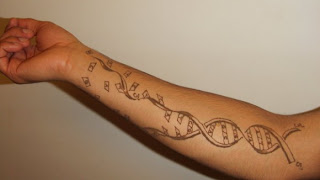
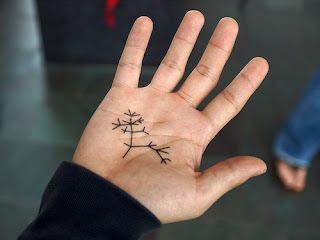
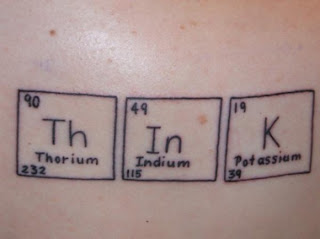
A few science majors and I have been wondering about tattoos in academia. Is any tattoo a taboo for the workplace? Are some fields more accepting than others? Should all tattoos be easily concealable? I asked the Bell lab during lab meeting today and got some interesting answers.
Think about the dress code
Do you want to one day work in a laboratory where everyone wears collared shirts? Do people at conferences wear ties all and dress shoes all five days? Do people sometimes wear their field clothing to lab? You can extend this thinking to predict how people will view a visible tattoo. Ecologists generally don't care. One graduate student mentioned an entomology professor at an eastern university who has both arms completely covered with ink. If you want to do medical research, on the other hand, you might want to think twice about a wrist, forearm, neck, etc. tattoo.
Do you want to one day work in a laboratory where everyone wears collared shirts? Do people at conferences wear ties all and dress shoes all five days? Do people sometimes wear their field clothing to lab? You can extend this thinking to predict how people will view a visible tattoo. Ecologists generally don't care. One graduate student mentioned an entomology professor at an eastern university who has both arms completely covered with ink. If you want to do medical research, on the other hand, you might want to think twice about a wrist, forearm, neck, etc. tattoo.
Think about the type of research
If the work you do concerns potentially very ill patients, some of whom may be in serious pain, you want to be as strictly professional as possible. This means no visible tattoos. Also, will the tattoo get in the way of the research you want to do? If you are an anthropologist traveling across the world, will a tattoo interfere with communicating and being trusted by the people you research? If you're a biologist wanting to do fieldwork in a conservative country, will that forearm tattoo be worth having your sleeves always rolled down, regardless of the weather?
Think about where you want to do research
Want to work at a private university? Think carefully: private institutions can discriminate applicants based on criteria they set. A Christian university, for example, can preferentially hire a less-qualified Christian applicant than a more-qualified non-Christian one. Public universities, on the other hand, are obligated to weigh all applicants equally. That means a candidate with a skull tattoo on his face will legally have to be considered as equally as a visually-conservative candidate. Getting a face tattoo, though, should bring up some red flags on these other points, though, so don't get too excited about getting 56 stars tattooed on your face.
Want to work at a private university? Think carefully: private institutions can discriminate applicants based on criteria they set. A Christian university, for example, can preferentially hire a less-qualified Christian applicant than a more-qualified non-Christian one. Public universities, on the other hand, are obligated to weigh all applicants equally. That means a candidate with a skull tattoo on his face will legally have to be considered as equally as a visually-conservative candidate. Getting a face tattoo, though, should bring up some red flags on these other points, though, so don't get too excited about getting 56 stars tattooed on your face.
Think about the tattoo
While the design you get on yourself is (or should be!) primarily for yourself, you might want to think twice if a skull and crossbones, or a bleeding heart, are the right images to be flaunting in a workplace. Some jobs don't care. A job where you're competing with others for grants and need to be taken seriously at conferences and lectures probably will care. In all contexts, a discrete tattoo is probably better than a bold one, and an easily-concealable tattoo is best.
I've taken care to make sure these guidelines pertain to visible tattoos. If the ink you get won't ever see the fluorescent lighting of the office you work in, go ahead and be bold. The pre-graduate route in undergrad is all about investing in the future. Yet, you could get hit by a car next week. Have you done everything you've wanted? Maybe you're worried that you won't like your tattoo when you're older. If you make sure you choose something that holds meaning to you now and will hold meaning to you later, don't forget that an older you is still you. If something means a lot to you and getting a tattoo commemorates that, you should go for it.
To finish off, I want to share some pictures I found after googling "science tattoo ideas." All photos are taken from http://oddstuffmagazine.com/tattoo-ideas-for-science-lovers.html.
-Matt
Saturday, October 8, 2011
Experiences with Research (Matt Grobis)
Hello all,
When I entered U of I, I knew that biology fascinated me and I wanted to learn as much as I could about it. As a junior in high school, reading Biology by Campbell and Reese changed the way I viewed the world. Our cells have dozens of mechanisms in place to ensure the successful copying of our DNA from one generation to the next, for infinite generations, yet mistakes in copying allow for evolution, for morphological diversification and adaptation to whatever an environment can throw at us. Yet it is also mistakes in copying that can cause cancer, where the stop signs in cells have been cut down and they can't stop dividing. Somewhere in the three trillion cells in our body, one or two have just now mutated into cancer, but thanks to our immune systems the cells quickly get killed. Orders of magnitude away, on the other spectrum of biology, I learned that an organism dying in the forest dissolves back into the component atoms, into life-giving nitrogen and phosphorus that trees readily suck up, into the carbon components that a detritovore then invests into its babies, who are later born as a pseudo-reincarnate of what just died. Animals have elaborate mechanisms to ensure they don't mate with the wrong species; in a world where a predator can snatch your life away at any moment, you can't waste time reproducing with someone who won't let you pass on your genes. The species that weren't careful enough didn't make enough babies and are now extinct. Maybe we can find their fossils and learn about them that way. Yet, for every fossilized species, one million other species were never fossilized because the conditions weren't perfectly aligned to preserve them.
I was hooked. I felt anything that I ever wanted to know about the world, I could find with biology. Yet, I didn't know how to translate this passion into something productive. Sure, I could take biology classes, study, and do well on exams... but I wanted something more, something that extended beyond just me. I wanted to learn as much as I could but then spread it as far as I could. Being a professor sounded perfect: I would wake up every day, eat breakfast, bike past old buildings where famous discoveries had been made, enter my laboratory, and begin working on the questions that teased us today but would be in the textbooks tomorrow (figuratively. It usually takes a decade or two for that to happen!). I would have a super-team of passionate post-docs, graduate students, and undergrads who I'd hand-selected for the motivation to answer the most difficult questions, the keystones to the future, the ones whose answers spawned more questions in the effort to understand how life on Earth works.
And so, I tried getting into research. I made the mistake of e-mailing labs based on the animals they worked with. Mammals sound cool, so neuroscience is great, right? Evo-devo? It took a few tries to realize that it's the questions researchers ask that matter. The organism they study is their means of answering the question. People study evolution in fruit flies instead of primates because it's WAY easier (picture the costs of housing a hundred chimpanzees for the 400 years it would take to do a 10-generation experiment). For me, I realized animal behavior was what really got me. When a fish is born, it has an awful lot to learn in a short amount of time. What can I eat? What can eat me? Where is safe? Who do I mate with and when? Who should I surround myself with? If I can't find food, do I look somewhere else or wait it out? At the risk of anthropomorphizing (attributing human characteristics to a non-human), I liked putting myself in the head of an animal living its normal life, interacting with other animals, learning what plants to eat or to avoid, learning what to do if it gets sick. How does the other 99.9999999% of life on Earth work if you take humans out of the picture? It's beautiful when you think about it.
Finally at the point where I'm applying for graduate schools, I've had to think a lot about what I want to do with my life. Similar to my freshman year, I want to do something more. A lot of people become professors, do their research, and call it a day. I applaud them. But, for me, I feel that I need to spread biology both within and beyond the academic world. Sometimes it amazes me the misconceptions non-biology majors may have about the natural world. And these are college students! Only 1% of the world's population has a college education. There is a lot of knowledge we need to spread. I want to write books for non-scientists one day, telling them exactly why biology is so interesting. They don't need to become researchers hunched over microscopes by the time they reach the back cover, but I want them to think. As the human population continues growing, it becomes increasingly important that we make the correct decisions regarding resource use and coexistence with wildlife. We can start by at least making sure everyone's on the same page.
When I was in Costa Rica last semester, Jordan Karubian, a professor from Tulane, gave a few guest lectures. While his research was very interesting, what really stuck with me was his efforts for outreach in the Chocó, a hyper-diverse tropical ecosystem in Ecuador. Aside from doing research, he fights deforestation by promoting sustainable practices among the local people. Some links to his work:
I want to do something like Dr. Karubian once I'm doing research. Right now, I'm idealistic. I think I can change the world. It sometimes seems so obvious how we can make things better. Yet so many people enter the real world and get bogged down. They get a bad boss, or their roommates never do the dishes, or they encounter a lot of administrative red tape when they want to do something more. They deflate. Someday they look back on college and chuckle at how idealistic they were, when in reality they just didn't know what the real world was like because they didn't have to pay taxes or work forty hours a week yet. Now, sure, some of this may be true. But it's at this point, bogged down and already working hard, that you can change the world. Yes, you can. Anyone can. The people who do are just the ones who believe it.
So, with that in mind... come to the IB Honors reading group on Fridays at the Union! Bring an article and friends, or just come to listen to some cool research. And then go change the world. :-)
-Matt
Subscribe to:
Posts (Atom)
