
Hi all!
So right now I'm at the Animal Behavior Society conference in Indiana. It's been so amazing. A research conference is essentially like college in that there are a few buildings (5 for ABS) with lectures going on concurrently, each 15-30 minutes long. You hop between lectures, choosing the ones you want, and eventually start seeing a lot of the same faces. Each morning and night are plenary talks, which are the biggest names at the conference (ABS paid them to come, for example, as opposed to us paying to be able to present). Their talks are scheduled so they don't interfere with anything and everyone basically goes to them. The plenaries are surprisingly unbelievably friendly... I talked to Hopi Hoekstra from Harvard who has absolutely fascinating research about the genetics of burrowing behavior after talk, for example. My question was pretty small and not that interesting but when I got up to her, she was like "Hi! My name is Hopi" and shook my hand, smiling. I was thinking "oh mah gash of course I know who you are." I asked her the question and she was like "great question! That's such an interesting area of research that we've been thinking about and there's some really cool stuff with etc. etc." and I about melted in pleasure, haha. Another plenary was Shelley Adamo, who looks at immunology (immune system and disease research) and I asked her some questions and she was about bouncing around in enthusiasm and passion. One of the plenaries, though, I tried talking to and she kind of ignored me, which was lame. Oh well.
But basically, you've got a collection of like-minded people who are really passionate about what they're studying. They're also emotionally invested into their work, and so when you're talking with them, you can see how much they love what they're doing, and so all these conversations around you are just filled with excitement and passion, and there's this feeling of communal care and happiness. It's such a great feeling.
There were two poster sessions in the midst of the conference. Relatively big results get talks, smaller results get posters. You hang up your ~1m x 0.75m poster on a board and then you stand next to it while people walk around. My result wasn't that exciting but surprisingly I got like 10-11 people who came by and really wanted to hear about it! There were some stickleback researchers who started debating theory as I was standing there, and started including me and I was kind of blown away and felt dumb for being the one presenting and them being my audience when I had minimal idea what they were talking about, hah! But they were really nice about it and taught me a little. The next day was a bit annoying when, after hanging out with everyone and talking and making connections, they all headed out to the bars while I went back to my room (I turn 21 in a few days), but otherwise it was fine.
So... I'm meeting a lot of people and it's so awesome. I was getting dinner in the cafeteria downstairs with a friend when I saw someone who I'd seen around a few times so I invited her to eat with us. Turns out she's a professor at a university in Liverpool! She was very friendly and we talked about her research while we ate. I've been going up to people whose talks were cool and talking with them afterwards, also. I talked to this girl from Cambridge who had a sweet talk about social conflict in corvids (ravens, crows, rooks, jays) and she recommended I contact this one guy at Cambridge who's looking for grad students! I e-mailed him last night and after nervously waiting for an hour checked my e-mail and saw a response! The response was "Mail delivery failure, destination not reached." Ahhhhhhh! haha. So, I searched for a while and found another address and tried that one. Today, I saw I got a response from him and he was really open to the idea and wants me to send him a proposal for a potential PhD project, which he said we can then work on together to make it feasible and work out! Woooow. I'm so excited. Getting into Cambridge would be insanely hard, though, and even if I get in, I can't work in a lab unless I also get outside funding, so I better get on that. But outside of Cambridge, I found a lady doing social work with corvids at University of Washington near Seattle, and she's looking for grad students, so I introduced myself last night and we talked for half an hour. I don't really want to go to UWash so I wasn't really nervous while talking to her, but there came a moment in the conversation when I was like "holy crap, I could be talking to my future advisor right now" and it made me a lot more serious in what I was talking about. Cool stuff! Options are nice.
Anyway, I'm going to grab lunch now. There's some more cool talks coming up and the plenary for tonight actually works with corvids, so I'm going to try to make a good impression when I ask him questions after his talk. I've had trouble sleeping the first few nights because i've been so excited about meeting all these people and being surrounded by such nerdiness, but I'm starting to get really tired... I'm basically on from 8am until midnight every day! The conference ends tomorrow at lunch and I'll be a bit disappointed but relieved it's over (no more chances to make a fool of myself, lol).
Take care,
-Matt
Thursday, July 28, 2011


Monday, May 16, 2011
Culture Shock (Matt Grobis)
I expected something akin to culture shock in January when I began my semester abroad in Costa Rica. The program was through the Organization for Tropical Studies and focused on tropical biology and conservation. We spent three and a half months at six research stations, frequently with no internet or hot water, doing fieldwork that required tall rubber boots to protect from snakes. We met farmers who work hard to produce goods like coffee or sugarcane and can only hope for favorable weather to make a profit that year. We got caught in the rain doing field research, watched sunsets on the ocean, spent hours identifying insects under microscopes and plants under hand lenses, picked cocoa fruit that would make the chocolate we later ate, and slept on long bus rides after nights full of dancing. Over those three and a half months, the twenty-eight of us were never apart for longer than a few hours; during our homestays in San José, the first thing we did with our free time was pile into a bus headed for San María de Dota to visit one of our Tico friends. The most privacy I had was when I showered; at all other times, there were six, ten people in a room with me.
I returned to the U.S. after a full day of flying, exhausted but happy to see my dad who picked me up from the airport. Driving home, I expected to feel something – joy, sadness, excitement – but I was too tired to react to the sights of the roads close to my home. My dog would have none of it, happily barking and whining when she saw me, running in with her eyes nearly shut from sleepiness, her tail hitting against kitchen cupboards. I closed the door to my room later and thought then I would feel something, but still, nothing. I smiled a little at the sound of frogs in the pond behind my house and then fell asleep.
The next day, my dad and I went to the mall to buy a cell phone for me because mine had broken right before Costa Rica. I immediately noticed how huge the mall was – three floors – and filled with anything you could want (except books, for some reason). There was even stuff you couldn’t possibly want but advertisements were everywhere, convincing you that you did. While I was buying the phone, the woman working there tried pushing all these extra accessories, most of which I didn’t need. Those I did, I noticed, were plastic-wrapped in a plastic box, handed to me in a plastic bag. On the drive back, I looked out the window at long empty fields devoid of trees next to the four-lane highway, the trees cut down to make room for more houses or stores. Today, I was walking my dog and stopped for the first time to look at one of the few trees on the walk. I saw simple opposite leaves with pinnate venation, as well as big interpetiolar stipules, and the thought that this far away from Costa Rica what I’d learned was still applicable made me smile. I passed big houses with huge lawns; meeting no one on my walk but being passed by numerous people in cars talking on their phones.
And now, finally back home after a long semester, I’ve finished most of the things I wanted to do when I got home. I’m sitting in a quiet room, listening to the frogs outside, looking at pictures of my last few nights in Costa Rica. I’m thinking about how different a lifestyle it was; today I asked my dad to buy vegetarian patties when he left for the supermarket. He came back with chicken patties and, when I asked him about it, gave me a look that seemed to say, “Why would anyone want vegetarian chicken?” My apple cores and banana peels are going into a garbage can heading for a landfill. There are so many bottles of water in my kitchen. My shower pumps at least twice as much water as anything I’d experienced the last four months. I feel I can’t live like I promised myself in Costa Rica, when I could walk through a rainforest that wasn’t yet cut down or admire an animal yet unaffected by climate change.
I’ll return to Costa Rica, undoubtedly, but until then, I have to find a way to merge these two lifestyles. Looking at the friendship bracelet Chesca made for me, I know I will see everyone again eventually. I miss you guys. See you soon.
-Matt
Tuesday, January 18, 2011
In search of tropical Christmas trees

Trudging through the snow this week on my return to Urbana, campus seems a bit lifeless. Most students and faculty are still away, and the few sprigs of green are mostly yew hedges, the occasional juniper, and the odd Scots pine. It’s odd to think that further north from here, where broadleaves make way for coniferous forests, much of the landscape is still green.
I’m coming back from the other direction. When I arrived in Panama last month, stores were filled with Christmas trees – pines and firs shipped down from North America and a little the worse for their long journey. Some traditions though defy translation, and I admit to buying my own ‘Chinese spruce’ (random six inch pieces of green plastic accompanied by some unintelligible instructions on assembly).
This year though, I’ve been in Panama on the trail of the true native tropical conifers. Most of the conifers we see in Illinois belong to families restricted to temperate regions – the pines (Pinaceae), junipers (Cupressaceae) and yews (Taxaceae), don’t occur in tropical forests. Conifers, in general, are successful at high latitudes because their needles are resistant to freezing and winter drought (when the soil is frozen), and because their narrow water-conducting tracheids are less vulnerable to freeze-thaw damage than the wider vessels found in most angiosperm wood. Tracheids though, have their own disadvantages. For the most part, conifers have needles or small scale-like leaves – their tracheid-based plumbing system simply precludes the development of broad, flattened leaves limiting their ability to array leaf surfaces to capture light in shady habitats, and limiting their capacity to match the fastest photosynthetic rates of rapidly transpiring sun-lit angiosperm leaves.
So, not surprisingly, conifers have been muscled out of much of the tropics. Pines still take a stand on cold mountain-tops in northern Central America and a few Caribbean islands, but once you reach the humid lowlands, conifers all but disappear. One family however makes an intriguing exception. A Gondwanian family of conifers, the Podocarpaceae, originated in the Jurassic (200 million years ago) and migrated into the tropics 50 million years ago, long after the rise of flowering plants. Podocarps can now be found in the peat swamp forests of SE Asia, lowland and montane forests of eastern Africa and all across South America and as far North as central Mexico.
So, how do they do it? We have a few ideas. For one thing, podocarps are never common. Instead, they seem to appear unexpectedly, in patches of otherwise rather open, scruffy forest. Our working hypothesis is that podocarps can only compete where soils are so infertile that the growth advantage of competing angiosperms is greatly reduced. Perhaps podocarps are especially good at either getting hold of scarce nutrients, or of making the most of the nutrients they have (a concept called ‘nutrient-use efficiency’). One trait that is particularly obvious is their peculiarly nodulated roots (seen here in a wet montane forest in western Panama, where podocarp roots grow out of the soil and up into the air).
We know the nodules don’t fix nitrogen, but the source of any other advantage they provide remains unclear.
This year I’ve set up some experiments on the ecophysiology of podocarps with colleagues Ben Turner and Klaus Winter at the Smithsonian Tropical Research Institute. Our first challenge was to find a source of podocarp seedlings.  As we want to compare the growth of podocarps with angiosperm trees of lowland forest we needed to find a population of podocarps growing at sea-level (as opposed to a colder mountain climate). Curiously, it turns out the only two lowland populations of podocarps in Panama grow on isolated islands – one Escudo de Veraguas, a tiny island miles from shore in the Caribbean. The other, the island of Coiba out in the Pacific and almost as remote
Travelling to Coiba is an Avatar-like experience. First, you leave the high rises of Panama City, a place of Miami-like excess. Then there’s the long hot drive along the Pan-American highway and finally a potholed trail through endless eroded hills and cattle pastures to the small coastal town of Santa Catalina. From there, Coiba is a two hour ride by panga – the fibreglass open boat and outboard motor found everywhere in the tropics. An hour down the coast the pastures disappear – there are no roads in this part of Panama – replaced by a wall of forest clinging to hills and cliffs and almost touching the ocean. We see humpback whales breaching in the deep channel between Coiba and the mainland, schools of tuna and bonito rippling the surface, and groups of leopard rays leaping to impossible heights before splashing back into the water.
Coiba is the largest island in Central America. Until a few years ago it was a notorious prison – much like Devil’s Island in French Guyana made famous by the book Papillon. For close to a century Coiba’s prisoners were left to roam the island and incarcerated only at night.  Not surprisingly, locals steered clear of Coiba. As a result, its forests and surrounding marine environment remained in near-pristine condition. Nowadays, Coiba and its surrounding waters are a National Park – visits to the island are tightly regulated. Fishing has been banned within a mile of the island. The results are spectacular – Coiba’s reefs are filled with the fish life that has mostly disappeared elsewhere in the Pacific – white tipped reef sharks abound along with turtles, and schools of huge red snapper and jack.
Coiba is surrounded by hundreds of smaller islands. One of them – Coibita – is home to a small and rustic (make that exceedingly rustic) field station managed by the Smithsonian and seldom visited.  After hauling out our food and water, we made our way to Playa Hermosa on the far side of Coiba, the location of the only patch of podocarps on the island. Why the podocarps grow here, and not elsewhere on the island remains unclear. The podocarp patch is on the edge of a fault line and it’s possible that the geology is unusual here. We’ll have to wait for results of our soil analyses. Arriving on a small stony beach its short climb up a steep embankment to a broad plateau. After a few minutes of searching we spot our first podocarp trees, and soon after discover carpets of recently germinated seedlings. It doesn’t take long to gather enough to take home.

Back at Gamboa (close to Panama City) our seedlings are now in Klaus Winter’s controlled environment greenhouses. Our first experiment is comparing podocarp responses to both reduced and elevated CO2 with responses of similar sized angiosperm seedlings and another conifer species Norfolk Island Pine (Araucaria heterophylla) – a Pacific Island endemic. Back in the Jurassic, when conifers ruled the world, atmospheric CO2 concentrations were four times current values, then steadily declined over the last 150 million years concurrent with the rise of Angiosperms. Could this decline in CO2 have altered the competitive balance between angiosperms and conifers? Stay tuned for our results.
Thursday, December 23, 2010
Greetings from Josie Chambers in La Esperanza Peru!
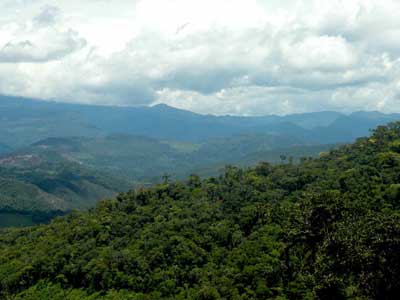
Hola! I am working here for the year as sustainable development coordinator for Neotropical Primate Conservation (NPC), an organization working to conserve the remaining habitat of the critically endangered yellow tailed woolly monkey.
I first arrived in the capital, Lima, over 2 months ago, and began the long journey to the village I have been working in. It was a 27 hours bus ride from Lima to Moyobamba, but the bus was really comfortable and as soon as the Peruvian couple sitting across the aisle and I realized we were each carrying a guitar and wearing New Balance shoes, I had good company for the long ride! Once in Moyobamba, I met up with the directors of NPC, as they were in town to give a presentation on wildlife trafficking. Coincidentally, the staff of the hostel we stayed at found a pet baby woolly monkey in one of the rooms the following morning. The trafficking of primates is unfortunately very common in the region. We transported the baby to a primate sanctuary in town, where it will be rehabilitated and hopefully released back into the wild at some point.
After first arriving in the village, La Esperanza – a few hours from Moyobamba – I met my housemate, a biologist from Lima who has been working with NPC for the past year. We set off to the forest that evening to monitor the Andean owl monkey, a nocturnal [meaning no photos - Ed.] primate species endemic to this region of Peru. We regularly observe a family of six that live in a small forest fragment near the village. They are extremely quiet travelers, and can be quite difficult to find, but luckily we found them and I spent my first night out in the forest!
After a few nights of monitoring the night monkeys, we set off with two Peruvian guides to find yellow tailed woolly monkeys in a forest area located a few hours walk from the village. The walk is a mixture of extreme downhills, uphills, and a lot of mud – although this turned out to be nothing compared to the challenging terrain at the actual site! The yellow tailed woolly monkey is also endemic to this region of Peru and is actually on the list of the 25 most endangered primates species in the world. We spent two full days searching the steep mountainsides for signs of monkey life, and finally found a group at the end of the second day.
 They are magnificent animals, with a thick reddish brown coat to cope with the relatively high altitude (1500-2100 m) and corresponding chilly climate. We are following groups in the area to gain a sense of behavioral patterns for this largely unstudied species, and NPC has been mapping out all remaining populations in Peru.
Another 3 hour hike back to La Esperanza and much needed shower later, and we were ready to set off again, but this time to the town of Chachapoyas. The University of Cajamarca had organized a Sustainable Development Conference, and we were scheduled to run half of the practical field course day. I met a few Peruvians working for a different conservation organization, focused on conserving Titi monkey habitat in the same region. We learned from experts who talked (of course all in Spanish!) about the economic valuation of nature, relationship between nature and indigenous cultures in the region, applications of GIS technology, diversity of bird species in Peru – to name a few things. On the final day, I helped the co–director of NPC run part of the field skills course, where we taught census methods, distance estimation, and GPS and binocular use in a forest reserve two hours away.
After the conference ended, I headed off with three new Peruvian friends to visit Kuelap,
 an archaeological site where the Chachapoyas (People of the Clouds) used to live before the Incas conquered the region. I traveled back to Tarapoto with one of my companions, an anthropologist, and stayed at her house before briefly returning to the States for my scholarship interviews.
Now that I have been back in Peru for almost a month, I am already finding myself busy splitting my time between the forest to monitor primate groups, villages to visit schools for environmental education activities, and the office to apply for grants to support community driven sustainable development opportunities. I had several highlights my first week back: realizing that I still have some volleyball skill left while playing with some local women while staying with a friend in Tarapoto, having amazing meals because a friend of one of the directors – a professional chef – visited for the week, and coincidentally meeting a good friend of the couple with the guitars I met on my first trip out. Now I have to visit all of them in Rioja at some point so we can all play guitar/sing together!
I actually had my first "mini concert" three weeks ago at a graduation ceremony for 5 year olds, where they all dressed up in suits and prom-esque gowns to celebrate the end of their first two years of school and official entrance into primary school. I was disappointed that I didn't have time to learn any Spanish songs beforehand, but at least they understood the word hallelujah that repeatedly came up in one of the songs! I’m currently developing lyrics and guitar chords to a yellow tailed woolly monkey (well, mono choro cola amarillo) song, which I hope to sing with kids in schools!
My second week back, we went out to the forest for my second 5-day spree with the yellow tailed woolly monkeys. Unfortunately this time they were acting more like wily monkeys; we found them on the morning of the very last day, but they managed to lose us after our 4-hour pursuit up steep mountain terrain!
Last week we traveled to a few different villages– some which can only be reached on foot – to carry out censuses of wildlife with Peruvian specialists and do environmental education activities at the schools. In one of these activities, the kids colored in different masks of animals that live in Peru, and we discussed where the animals live, what they eat, interesting behavior, and why it’s important to protect their forest habitat.

Now that I’ve been back to La Esperanza for a few days now, I’ve had chance to finally focus more on my main role with the organization – to promote opportunities for sustainable development in the region. This means searching for funding to support community projects growing Sacha inchi, producing dry fruits, making handicrafts, and developing ecotourism, as well as establishing contacts within and outside Peru to help develop such programs. I am focusing my initial efforts on developing the production of Sacha Inchi, as the variety in this region has high market potential and naturally grows well alongside reforestation efforts. Progress was challenging this past weekend with just one hour of power/internet per day; however, the heavy Monday night rains assured that we will have solid hydroelectric power for the next few days at least. This has allowed me to finish an executive summary of Sacha Inchi production in the region, begin setting up meetings in Lima for mid-January, and start contacting foundations for funding opportunities.
Of course there have been quite a few challenges along the way - 14 eggs in 3 days (and the 25 last week) isn't exactly making me feel the healthiest, my nearly 100 bites from a combination of mosquitoes and using a flea infested sleeping bag for a few days in the forest is getting a bit tiresome, my far from perfect Spanish sometimes makes communication difficult, and I've certainly had many difficult extremely steep and muddy hikes (and naturally accompanying bruises, blisters, and lots of laundry)! It keeps me on my toes though, and is a tiny price to pay for the many positive experiences I’ve had working here.
I've already had the opportunity to make so many valuable connections with people working towards environmental justice in villages and through organizations. Last week, I stayed with a family for a night in a remote village called La Primavera to do environmental education activities in the school. The father Eugenio produces coffee in a cooperative and they direct much of their additional effort to planting native tree species in their village. They're up to over 2,500 new trees now. His brother José, who came over for dinner, has developed a society for the defense of nature in the village in response to the tragic clashes between police and indigenous communities in Bagua last year over the economic development of their land. José’s group does environmental education and reforestation activities in the village and surrounding area. It's truly inspiring to meet such dedicated people, and lights even more of a fire underneath me to search for opportunities that can provide support for such efforts.
In the coming days, I will be continuing with internet work and night monkey monitoring, and celebrating the holidays with the other volunteers here by playing with kids in the village and eating Panetón, a traditional Peruvian Christmas cake!
Best wishes for a wonderful new year and happy holidays!
Josie
[Editor's note: Josie is a 2010 IBHonors grad, currently taking a "gap year" before beginning a two year Marshall Scholarship at Edinburgh and Cambridge Universities]
Tuesday, November 9, 2010
Reflections (Matt Grobis)
Hi again, after an extended hiatus...
IB Honors is almost over. Well, the core is at least. It's weird to say that... I feel like college didn't really start until IBH did. It's been a rocky road but I'm so happy with the results. I view it as a shaping process - we were put out of our comfort zone and had to change who we were to manage in the new environment. It was really hard at first but being on this side of the hurdle, with only a few requirements and some relatively easy 400-level IB classes left to take, I can't help but feel like I'm ready to take on whatever I launch myself into after college, be it grad school, volunteering, or some avenue completely unrelated. If I can get through IB Honors, I feel I can handle whatever is thrown at me.
Speaking of what's on the horizon, I'm not really sure (though I doubt anyone is, especially at this point of our lives). I switched from the Sears lab to the Bell lab and have found an area of biology I really love - behavior - and I can't wait to work on my own research. I'm interested in social behavior (e.g. how can an ant colony consisting of potentially thousands of individuals operate without a true central intelligence?), tool use (what combination of genes allow crows the mental capacity to use tools but not other species?), and learning (one study Dr. Suarez told me about involved teaching one crow how to use a particular tool and then watching how long it took for other crows in the vicinity to learn how to use the tool just by watching). Working in the Bell lab is interesting enough, but to be in charge of my own project, with my own species of interest and exact project framework I want... well, let's just say I've already browsed my fair share of grad schools' biology faculty and started rehearsing the 50 most common vocab words on the GRE.
At the same time, though, I entered U of I an English major and still have a dream to publish a novel. Free from hours of classes, homework, and labwork, why not explore avenues of my life that I turned down for biology? What about taking a year, volunteering for part of it, and then getting a one-bedroom apartment in Seattle or some other place far from home, working at Starbucks during the day and then at night cranking out this novel I've had in my head for the last year (and am trying to write every day)? In other words... why do I have to start the rest of my life now? Grad school is a tremendous commitment and doesn't allow much time for outside interests (i.e. writing a novel). And call me paranoid, but I don't think I've met a single person in grad school who isn't in a committed relationship or married. Trying to explain to my significant other that I "just want to work at Starbucks in California and work on this story I've been writing... you know?" when she wants to settle down doesn't seem like it'll work out very well.
Taking a year off might be the hardest thing I've ever done but I feel like I won't be completely satisfied if I don't. I love biology and can't wait to dedicate my life to trying to unravel its mysteries, but what about everything else? Maybe this is a hippie thought, but I've had this desire to... give thanks to what has been given to me. Karate changed my life - it gave me the tools to defend myeslf but more importantly it gave me self confidence, discipline, and taught me respect. Part of me wants to go to Okinawa, the birthplace of Shotokan karate, and... I don't know. Pay my respects. Say thank you. I feel the same way about Poland. I'm 100% Polish - I consider myself American but in the end I am completely Polish - but I have done nothing to Poland besides visit family there. I want to get a job there for a little while, basically give something back to Poland. And even considering what biology has taught me, I want to give back to the Earth by volunteering with conservation or helping underpriviledged children in other countries. I'm not saying I'll definitely go to Okinawa, Poland, or a country in South America or Africa, but taking a year off at least gives me the opportunity to give back in some way, whatever it may be.
And then, of course, grad school. :-)
I'll keep writing in this... part of me wishes I could just see an entry in this blog from two years down the road, where I'll be halfway through this potentially crazy gap year. But then again... with everything I could cram into a whole year, maybe the real excitement lies in the unknown.
-Matt
IB Honors is almost over. Well, the core is at least. It's weird to say that... I feel like college didn't really start until IBH did. It's been a rocky road but I'm so happy with the results. I view it as a shaping process - we were put out of our comfort zone and had to change who we were to manage in the new environment. It was really hard at first but being on this side of the hurdle, with only a few requirements and some relatively easy 400-level IB classes left to take, I can't help but feel like I'm ready to take on whatever I launch myself into after college, be it grad school, volunteering, or some avenue completely unrelated. If I can get through IB Honors, I feel I can handle whatever is thrown at me.
Speaking of what's on the horizon, I'm not really sure (though I doubt anyone is, especially at this point of our lives). I switched from the Sears lab to the Bell lab and have found an area of biology I really love - behavior - and I can't wait to work on my own research. I'm interested in social behavior (e.g. how can an ant colony consisting of potentially thousands of individuals operate without a true central intelligence?), tool use (what combination of genes allow crows the mental capacity to use tools but not other species?), and learning (one study Dr. Suarez told me about involved teaching one crow how to use a particular tool and then watching how long it took for other crows in the vicinity to learn how to use the tool just by watching). Working in the Bell lab is interesting enough, but to be in charge of my own project, with my own species of interest and exact project framework I want... well, let's just say I've already browsed my fair share of grad schools' biology faculty and started rehearsing the 50 most common vocab words on the GRE.
At the same time, though, I entered U of I an English major and still have a dream to publish a novel. Free from hours of classes, homework, and labwork, why not explore avenues of my life that I turned down for biology? What about taking a year, volunteering for part of it, and then getting a one-bedroom apartment in Seattle or some other place far from home, working at Starbucks during the day and then at night cranking out this novel I've had in my head for the last year (and am trying to write every day)? In other words... why do I have to start the rest of my life now? Grad school is a tremendous commitment and doesn't allow much time for outside interests (i.e. writing a novel). And call me paranoid, but I don't think I've met a single person in grad school who isn't in a committed relationship or married. Trying to explain to my significant other that I "just want to work at Starbucks in California and work on this story I've been writing... you know?" when she wants to settle down doesn't seem like it'll work out very well.
Taking a year off might be the hardest thing I've ever done but I feel like I won't be completely satisfied if I don't. I love biology and can't wait to dedicate my life to trying to unravel its mysteries, but what about everything else? Maybe this is a hippie thought, but I've had this desire to... give thanks to what has been given to me. Karate changed my life - it gave me the tools to defend myeslf but more importantly it gave me self confidence, discipline, and taught me respect. Part of me wants to go to Okinawa, the birthplace of Shotokan karate, and... I don't know. Pay my respects. Say thank you. I feel the same way about Poland. I'm 100% Polish - I consider myself American but in the end I am completely Polish - but I have done nothing to Poland besides visit family there. I want to get a job there for a little while, basically give something back to Poland. And even considering what biology has taught me, I want to give back to the Earth by volunteering with conservation or helping underpriviledged children in other countries. I'm not saying I'll definitely go to Okinawa, Poland, or a country in South America or Africa, but taking a year off at least gives me the opportunity to give back in some way, whatever it may be.
And then, of course, grad school. :-)
I'll keep writing in this... part of me wishes I could just see an entry in this blog from two years down the road, where I'll be halfway through this potentially crazy gap year. But then again... with everything I could cram into a whole year, maybe the real excitement lies in the unknown.
-Matt
Saturday, September 4, 2010
Field Trips and Evolution! (Matt Grobis)
Hello!
The year is off to a good start. Last weekend was the IB 372 field trip to southern Illinois for fieldwork and it was a blast. The trip started on Friday at 5pm, when the class met outside Morrill and divided into three vans that soon headed south on I-57. I knew I'd be hungry but figured I would just wait until we stopped at a McDonalds or something; my friend Cally, on the other hand, nonchalantly pulled out two enormous loaves of bread from her bag and offered them to us. To make it even more random, her neighbors had just handed the bread to her right before she left for Morrill. The food was delicious and the drive full of jokes, stories about Africa, singing along to the radio, and intellectual exploration. Gotta love IBH.
We slept at a research station (basically a log cabin) and spent most of Saturday and Sunday outside. On Saturday, we got up at 8am to begin the first part of the day - insect collection. We wanted to analyze insect diversity in three different environments - a so ybean field, grassland, and woodland. With huge butterfly nets (just like you'd picture one), we walked through waist-high soybeans, grasses, or bushes while swiping the net back and forth. You couldn't see anything in the greenery so it was really surprising emptying a seemingly empty net into a plastic bag and seeing dozens of flies, spiders, ticks, caterpillars, grasshoppers, beetles, moths, midges, and more. Speaking of ticks, we all had a lovely time combing our legs for them afterwards and finding an uncomfortably high number of them, especially baby ones that look like tiny dots.
Anyway, the picture on the right is from the soybean field. We went to the grassland and then woodland after that before returning to the station for lunch and then heading out again for the second part of the day - soil analysis. After a small hike in the woods, we found a bog where the ground sloped upwards away from it so we decided to do our research here. We took soil samples to look at the amounts of water and organic carbon in relation to distance from the bog and we looked at the number and diameter of trees in each corresponding area. We also took fish-eye photographs of the tree canopy (by pointing a nice camera straight up and crouching to avoid being in picture) to look at amount of sunlight. When we finally got back to the station, we began sorting the insects into morphospecies (basically, what does this individual look like it could be?) before a delicious dinner of chili courtesy of Dr. Dalling. After more insect sorting, we headed to a campfire and had s'mores while Dr. Berlocher played guitar and we sang (or, as in my case, listened while those who could sing chose to do so) oldies.
Sunday was much more relaxed, with a hike, lunch, and then drive back to U of I to finally start homework for other classes. It's a good idea to have this field trip during the first weekend because fortunately I didn't have very much. Speaking of classes, though, I get to the second part of the title of this entry: evolution. Evolution fascinates me and I hope to some day do work that incorporates it. One of the biggest debates among evolutionary biologists right now is what level of organization does evolution occur. Is it at the gene, like Dawkins argued, the organism, or the group, which Wynne-Edwards believed? Last year, I took a class called PSYC 433 - Evolutionary Neuroscience, with Dr. Justin Rhodes. He showed us support for the group selection argument and hammered it into our heads that selection can occur at this stage (we're talking exam questions where the correct answer is 'group selection'). He made some really interesting points and I could see the logic in his arguments.
Then on Friday, in my IB 429 - Animal Behavior class, Dr. Andrew Suarez spent at least ten minutes stressing that group selection does not occur and it's a mental fallacy. He showed us the problems with group selection models and argued that kin selection, which is a form of selection at the individual level, can frequently be used to explain group selection arguments. We talked for fifteen minutes after class about this dichotomy between individual and group selection theories and he said he had a history of debating the topic with Dr. Rhodes.
I think this is fascinating. Here we are, at the very edge of scientific knowledge, trying to figure out which way is correct (or perhaps if there is a third way that combines the two or a fourth way completely unrelated). Two reputable, extremely intelligent scientists are confronting the same problem and arriving at conflicting answers. Fifty years from now, maybe the problem will be resolved and it'll just be a bullet point on a powerpoint slide (or a program you input into a chip in your brain? Crazy...). But right now, we're pushing at that boundary. What sort of questions will we be asking in fifty years?
Heading into the future with an open mind,
-Matt
p.s: as to where I fall on the evolution question (as if I have any credibility at all), I think there might be a little of both factoring into the answer. Do the options have to be mutually exclusive? I'm thinking of meeting with Dr. Rhodes again and seeing what he has to say again.
The year is off to a good start. Last weekend was the IB 372 field trip to southern Illinois for fieldwork and it was a blast. The trip started on Friday at 5pm, when the class met outside Morrill and divided into three vans that soon headed south on I-57. I knew I'd be hungry but figured I would just wait until we stopped at a McDonalds or something; my friend Cally, on the other hand, nonchalantly pulled out two enormous loaves of bread from her bag and offered them to us. To make it even more random, her neighbors had just handed the bread to her right before she left for Morrill. The food was delicious and the drive full of jokes, stories about Africa, singing along to the radio, and intellectual exploration. Gotta love IBH.
We slept at a research station (basically a log cabin) and spent most of Saturday and Sunday outside. On Saturday, we got up at 8am to begin the first part of the day - insect collection. We wanted to analyze insect diversity in three different environments - a so
 ybean field, grassland, and woodland. With huge butterfly nets (just like you'd picture one), we walked through waist-high soybeans, grasses, or bushes while swiping the net back and forth. You couldn't see anything in the greenery so it was really surprising emptying a seemingly empty net into a plastic bag and seeing dozens of flies, spiders, ticks, caterpillars, grasshoppers, beetles, moths, midges, and more. Speaking of ticks, we all had a lovely time combing our legs for them afterwards and finding an uncomfortably high number of them, especially baby ones that look like tiny dots.
Anyway, the picture on the right is from the soybean field. We went to the grassland and then woodland after that before returning to the station for lunch and then heading out again for the second part of the day - soil analysis. After a small hike in the woods, we found a bog where the ground sloped upwards away from it so we decided to do our research here. We took soil samples to look at the amounts of water and organic carbon in relation to distance from the bog and we looked at the number and diameter of trees in each corresponding area. We also took fish-eye photographs of the tree canopy (by pointing a nice camera straight up and crouching to avoid being in picture) to look at amount of sunlight. When we finally got back to the station, we began sorting the insects into morphospecies (basically, what does this individual look like it could be?) before a delicious dinner of chili courtesy of Dr. Dalling. After more insect sorting, we headed to a campfire and had s'mores while Dr. Berlocher played guitar and we sang (or, as in my case, listened while those who could sing chose to do so) oldies.
Sunday was much more relaxed, with a hike, lunch, and then drive back to U of I to finally start homework for other classes. It's a good idea to have this field trip during the first weekend because fortunately I didn't have very much. Speaking of classes, though, I get to the second part of the title of this entry: evolution. Evolution fascinates me and I hope to some day do work that incorporates it. One of the biggest debates among evolutionary biologists right now is what level of organization does evolution occur. Is it at the gene, like Dawkins argued, the organism, or the group, which Wynne-Edwards believed? Last year, I took a class called PSYC 433 - Evolutionary Neuroscience, with Dr. Justin Rhodes. He showed us support for the group selection argument and hammered it into our heads that selection can occur at this stage (we're talking exam questions where the correct answer is 'group selection'). He made some really interesting points and I could see the logic in his arguments.
Then on Friday, in my IB 429 - Animal Behavior class, Dr. Andrew Suarez spent at least ten minutes stressing that group selection does not occur and it's a mental fallacy. He showed us the problems with group selection models and argued that kin selection, which is a form of selection at the individual level, can frequently be used to explain group selection arguments. We talked for fifteen minutes after class about this dichotomy between individual and group selection theories and he said he had a history of debating the topic with Dr. Rhodes.
I think this is fascinating. Here we are, at the very edge of scientific knowledge, trying to figure out which way is correct (or perhaps if there is a third way that combines the two or a fourth way completely unrelated). Two reputable, extremely intelligent scientists are confronting the same problem and arriving at conflicting answers. Fifty years from now, maybe the problem will be resolved and it'll just be a bullet point on a powerpoint slide (or a program you input into a chip in your brain? Crazy...). But right now, we're pushing at that boundary. What sort of questions will we be asking in fifty years?
Heading into the future with an open mind,
-Matt
p.s: as to where I fall on the evolution question (as if I have any credibility at all), I think there might be a little of both factoring into the answer. Do the options have to be mutually exclusive? I'm thinking of meeting with Dr. Rhodes again and seeing what he has to say again.
Tuesday, August 17, 2010
Enjoying Summer (Matt Grobis)
Hi all,
It's definitely nice being on this side of calc III... I finished summer classes, which included calc 3 and creative writing, last week and have finally had what I could call a "real" summer vacation. Calc 3 was a pretty nasty hurdle and I actually questioned IB Honors towards the end of the class... if I wanted to go to a good graduate school, wouldn't a better GPA help more than a mediocre grade in advanced calculus? Why was I stressing myself out learning about Green's Theorem, triple integrals, and partial derivative chain rules if I wanted to work with conservation in the future? In theory, taking all these hard classes would make us smarter but in reality, wasn't it just another hoop to jump through?
Having finished Calc 3, I'm a lot more ambivalent about its inclusion in the IBH curriculum. Sure, it was stressful, but education is about broadening your horizons and better understanding the world, and learning all about calculations with multiple variables does that... right? At any rate, maybe I'll be using something similar in the future. I was dead-set on being an English major from when I was nine until senior year in high school, and now I'm on the pre-graduate path for science. If I had never taken AP Bio in high school, there's a good chance I wouldn't have discovered that I love biology. Take a chance, then... maybe you'll find something you wouldn't have otherwise.
I do have one suggestion for the IBH curriculum, though. Instead of automatically gearing towards receiving a chemistry minor, it would be cool if students could have a choice between two or three different "minor concentrations" they could choose. For example, I find astrobiology fascinating. Having the opportunity to IBH minor in physics or astronomy, I may have preferred choosing that over chemistry. Chemistry is probably the most practical and relevant to biology, but if IBH stresses that it prepares students for any field (according to the program description), wouldn't it be cool if students had a little more say in how they handled this education given to them? Just a thought.
My dog is whining at me so I'm going to walk her now. See you all in a week!
-Matt
It's definitely nice being on this side of calc III... I finished summer classes, which included calc 3 and creative writing, last week and have finally had what I could call a "real" summer vacation. Calc 3 was a pretty nasty hurdle and I actually questioned IB Honors towards the end of the class... if I wanted to go to a good graduate school, wouldn't a better GPA help more than a mediocre grade in advanced calculus? Why was I stressing myself out learning about Green's Theorem, triple integrals, and partial derivative chain rules if I wanted to work with conservation in the future? In theory, taking all these hard classes would make us smarter but in reality, wasn't it just another hoop to jump through?
Having finished Calc 3, I'm a lot more ambivalent about its inclusion in the IBH curriculum. Sure, it was stressful, but education is about broadening your horizons and better understanding the world, and learning all about calculations with multiple variables does that... right? At any rate, maybe I'll be using something similar in the future. I was dead-set on being an English major from when I was nine until senior year in high school, and now I'm on the pre-graduate path for science. If I had never taken AP Bio in high school, there's a good chance I wouldn't have discovered that I love biology. Take a chance, then... maybe you'll find something you wouldn't have otherwise.
I do have one suggestion for the IBH curriculum, though. Instead of automatically gearing towards receiving a chemistry minor, it would be cool if students could have a choice between two or three different "minor concentrations" they could choose. For example, I find astrobiology fascinating. Having the opportunity to IBH minor in physics or astronomy, I may have preferred choosing that over chemistry. Chemistry is probably the most practical and relevant to biology, but if IBH stresses that it prepares students for any field (according to the program description), wouldn't it be cool if students had a little more say in how they handled this education given to them? Just a thought.
My dog is whining at me so I'm going to walk her now. See you all in a week!
-Matt
Subscribe to:
Posts (Atom)
