Showing posts with label ibh. Show all posts

Thursday, December 23, 2010

Greetings from Josie Chambers in La Esperanza Peru!


Hola! I am working here for the year as sustainable development coordinator for Neotropical Primate Conservation (NPC), an organization working to conserve the remaining habitat of the critically endangered yellow tailed woolly monkey.

I first arrived in the capital, Lima, over 2 months ago, and began the long journey to the village I have been working in. It was a 27 hours bus ride from Lima to Moyobamba, but the bus was really comfortable and as soon as the Peruvian couple sitting across the aisle and I realized we were each carrying a guitar and wearing New Balance shoes, I had good company for the long ride! Once in Moyobamba, I met up with the directors of NPC, as they were in town to give a presentation on wildlife trafficking. Coincidentally, the staff of the hostel we stayed at found a pet baby woolly monkey in one of the rooms the following morning. The trafficking of primates is unfortunately very common in the region. We transported the baby to a primate sanctuary in town, where it will be rehabilitated and hopefully released back into the wild at some point.

After first arriving in the village, La Esperanza – a few hours from Moyobamba – I met my housemate, a biologist from Lima who has been working with NPC for the past year. We set off to the forest that evening to monitor the Andean owl monkey, a nocturnal [meaning no photos - Ed.] primate species endemic to this region of Peru. We regularly observe a family of six that live in a small forest fragment near the village. They are extremely quiet travelers, and can be quite difficult to find, but luckily we found them and I spent my first night out in the forest!

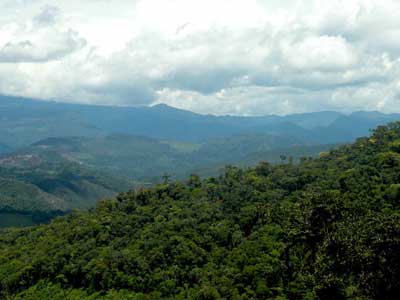
After a few nights of monitoring the night monkeys, we set off with two Peruvian guides to find yellow tailed woolly monkeys in a forest area located a few hours walk from the village. The walk is a mixture of extreme downhills, uphills, and a lot of mud – although this turned out to be nothing compared to the challenging terrain at the actual site! The yellow tailed woolly monkey is also endemic to this region of Peru and is actually on the list of the 25 most endangered primates species in the world. We spent two full days searching the steep mountainsides for signs of monkey life, and finally found a group at the end of the second day. They are magnificent animals, with a thick reddish brown coat to cope with the relatively high altitude (1500-2100 m) and corresponding chilly climate. We are following groups in the area to gain a sense of behavioral patterns for this largely unstudied species, and NPC has been mapping out all remaining populations in Peru.

Another 3 hour hike back to La Esperanza and much needed shower later, and we were ready to set off again, but this time to the town of Chachapoyas. The University of Cajamarca had organized a Sustainable Development Conference, and we were scheduled to run half of the practical field course day. I met a few Peruvians working for a different conservation organization, focused on conserving Titi monkey habitat in the same region. We learned from experts who talked (of course all in Spanish!) about the economic valuation of nature, relationship between nature and indigenous cultures in the region, applications of GIS technology, diversity of bird species in Peru – to name a few things. On the final day, I helped the co–director of NPC run part of the field skills course, where we taught census methods, distance estimation, and GPS and binocular use in a forest reserve two hours away.

After the conference ended, I headed off with three new Peruvian friends to visit Kuelap, an archaeological site where the Chachapoyas (People of the Clouds) used to live before the Incas conquered the region. I traveled back to Tarapoto with one of my companions, an anthropologist, and stayed at her house before briefly returning to the States for my scholarship interviews.

Now that I have been back in Peru for almost a month, I am already finding myself busy splitting my time between the forest to monitor primate groups, villages to visit schools for environmental education activities, and the office to apply for grants to support community driven sustainable development opportunities. I had several highlights my first week back: realizing that I still have some volleyball skill left while playing with some local women while staying with a friend in Tarapoto, having amazing meals because a friend of one of the directors – a professional chef – visited for the week, and coincidentally meeting a good friend of the couple with the guitars I met on my first trip out. Now I have to visit all of them in Rioja at some point so we can all play guitar/sing together!

I actually had my first "mini concert" three weeks ago at a graduation ceremony for 5 year olds, where they all dressed up in suits and prom-esque gowns to celebrate the end of their first two years of school and official entrance into primary school. I was disappointed that I didn't have time to learn any Spanish songs beforehand, but at least they understood the word hallelujah that repeatedly came up in one of the songs! I’m currently developing lyrics and guitar chords to a yellow tailed woolly monkey (well, mono choro cola amarillo) song, which I hope to sing with kids in schools!

My second week back, we went out to the forest for my second 5-day spree with the yellow tailed woolly monkeys. Unfortunately this time they were acting more like wily monkeys; we found them on the morning of the very last day, but they managed to lose us after our 4-hour pursuit up steep mountain terrain!

Last week we traveled to a few different villages– some which can only be reached on foot – to carry out censuses of wildlife with Peruvian specialists and do environmental education activities at the schools. In one of these activities, the kids colored in different masks of animals that live in Peru, and we discussed where the animals live, what they eat, interesting behavior, and why it’s important to protect their forest habitat.


Now that I’ve been back to La Esperanza for a few days now, I’ve had chance to finally focus more on my main role with the organization – to promote opportunities for sustainable development in the region. This means searching for funding to support community projects growing Sacha inchi, producing dry fruits, making handicrafts, and developing ecotourism, as well as establishing contacts within and outside Peru to help develop such programs. I am focusing my initial efforts on developing the production of Sacha Inchi, as the variety in this region has high market potential and naturally grows well alongside reforestation efforts. Progress was challenging this past weekend with just one hour of power/internet per day; however, the heavy Monday night rains assured that we will have solid hydroelectric power for the next few days at least. This has allowed me to finish an executive summary of Sacha Inchi production in the region, begin setting up meetings in Lima for mid-January, and start contacting foundations for funding opportunities.

Of course there have been quite a few challenges along the way - 14 eggs in 3 days (and the 25 last week) isn't exactly making me feel the healthiest, my nearly 100 bites from a combination of mosquitoes and using a flea infested sleeping bag for a few days in the forest is getting a bit tiresome, my far from perfect Spanish sometimes makes communication difficult, and I've certainly had many difficult extremely steep and muddy hikes (and naturally accompanying bruises, blisters, and lots of laundry)! It keeps me on my toes though, and is a tiny price to pay for the many positive experiences I’ve had working here.

I've already had the opportunity to make so many valuable connections with people working towards environmental justice in villages and through organizations. Last week, I stayed with a family for a night in a remote village called La Primavera to do environmental education activities in the school. The father Eugenio produces coffee in a cooperative and they direct much of their additional effort to planting native tree species in their village. They're up to over 2,500 new trees now. His brother José, who came over for dinner, has developed a society for the defense of nature in the village in response to the tragic clashes between police and indigenous communities in Bagua last year over the economic development of their land. José’s group does environmental education and reforestation activities in the village and surrounding area. It's truly inspiring to meet such dedicated people, and lights even more of a fire underneath me to search for opportunities that can provide support for such efforts.

In the coming days, I will be continuing with internet work and night monkey monitoring, and celebrating the holidays with the other volunteers here by playing with kids in the village and eating Panetón, a traditional Peruvian Christmas cake!

Best wishes for a wonderful new year and happy holidays!
Josie

[Editor's note: Josie is a 2010 IBHonors grad, currently taking a "gap year" before beginning a two year Marshall Scholarship at Edinburgh and Cambridge Universities]

Tuesday, August 17, 2010

Enjoying Summer (Matt Grobis)

Hi all,

It's definitely nice being on this side of calc III... I finished summer classes, which included calc 3 and creative writing, last week and have finally had what I could call a "real" summer vacation. Calc 3 was a pretty nasty hurdle and I actually questioned IB Honors towards the end of the class... if I wanted to go to a good graduate school, wouldn't a better GPA help more than a mediocre grade in advanced calculus? Why was I stressing myself out learning about Green's Theorem, triple integrals, and partial derivative chain rules if I wanted to work with conservation in the future? In theory, taking all these hard classes would make us smarter but in reality, wasn't it just another hoop to jump through?

Having finished Calc 3, I'm a lot more ambivalent about its inclusion in the IBH curriculum. Sure, it was stressful, but education is about broadening your horizons and better understanding the world, and learning all about calculations with multiple variables does that... right? At any rate, maybe I'll be using something similar in the future. I was dead-set on being an English major from when I was nine until senior year in high school, and now I'm on the pre-graduate path for science. If I had never taken AP Bio in high school, there's a good chance I wouldn't have discovered that I love biology. Take a chance, then... maybe you'll find something you wouldn't have otherwise.

I do have one suggestion for the IBH curriculum, though. Instead of automatically gearing towards receiving a chemistry minor, it would be cool if students could have a choice between two or three different "minor concentrations" they could choose. For example, I find astrobiology fascinating. Having the opportunity to IBH minor in physics or astronomy, I may have preferred choosing that over chemistry. Chemistry is probably the most practical and relevant to biology, but if IBH stresses that it prepares students for any field (according to the program description), wouldn't it be cool if students had a little more say in how they handled this education given to them? Just a thought.

My dog is whining at me so I'm going to walk her now. See you all in a week!
-Matt

Monday, May 17, 2010

Now that it's over... (Matt Grobis)

Now what? haha. Summer vacation is lovely... get up when you want, sleep how much you want, no work, just fun... interestingly enough, I'm glad this will only last about a week. It's nice to get out the Xbox and play games I haven't played in months, sleep 9-10 hours a day, and not have the stress of always having to do something on my mind, but I can't help but feel like I should be doing something... more. I suppose in the end it really is all about balance; in the midst of paper-writing and studying for finals last week, I gladly welcomed days with absolutely nothing on the planner. Now, though, once I've blown up a good share of mutated monsters' heads in Fallout 3 I can't help but desire some sort of structure to my days.

Like I said, though, things are good. I'm leaving for South Africa this Thursday and I'll be there for three weeks. It's a program through U of I about wildlife conservation and management along with learning about the various ecosystems in the region. We'll mainly be in national parks and the last six days or so will be spent hiking and camping... very excited for that. Apparently the trip starts with looking at animals through bars (in an animal rescue center, for example), then looking at them through the Jeep windows, and then seeing them while actually walking around. There's something called the "titanic seat" on the Jeep, which is a seat at the very front of the car, actually on top of the engine area. All of us on the trip (~10) are fortunate enough to get a turn on that seat (:-\)! When we're driving around and passing leopards and elephants, I wouldn't be surprised to feel like I was about to get mauled at any moment. No casualties so far, though, they've said. I won't be taking antimalarial medication because we're going during Africa's winter and mosquitoes aren't active at this time. I did get a hepatitis A shot and am taking an oral typhoid fever vaccine from McKinley, however.

Speaking of Africa's winter, I feel compelled to share something. When I tell people I'm packing for my trip to Africa, they're usually like "oh, so you're bringing lots of shirts and shorts and sun screen, right?" Then I tell them we'll be there during Africa's winter and they say, "oh, so you're bringing lots of sweatshirts and pants and stuff, right?" Turns out that both sun screen and a heavy winter coat are on the packing list. Winter in Africa means the temperature is a little below freezing at night and then over 100F during the day. Yeah. That's insane. Layers, they keep reminding us. I'm really curious about the resilience and determination of life in this climate at such an intense temperature range. These parts of Africa are extremely diverse despite the seemingly unfavorable conditions. If the conditions are predictable and regular, though, it makes sense that something out there found a way to survive in them.

When I get back, I've got a few days to myself and then I'm off to U of I again to take some classes and continue research in my lab. Some of my IBH friends will be around so I'm looking forward to hanging out with them in a non-stressed setting :-) It's looking to be a good summer.

Finally getting some sleep and about to go play some more Xbox (while I still can!),
-Matt

Monday, April 19, 2010

Keeping a Good Lab Journal (Matt Grobis)

I feel like I learned a lesson today that IBH has been trying to drill into our heads from day one.

I came into the Sears lab today with instructions to set up some opossum matings + tapes and then prepare some primers for PCR. The opossum matings went fine; I've been doing this every Monday since the start of the semester and lately it's been going really well. I got back upstairs, hung up the lab coat, put away the keys and i-card (I'm still not authorized downstairs) and got to my lab bench and...

Now what? I stared at the two boxes of primers for a moment before rifling through my bag to look at the notes I had taken from two weeks ago, when the P.I. (Dr. Sears, the head of the lab) and I did this for the first time. They were brief and scattered but had immense holes in them - did I add the ddH2O directly to the capsules, did I centrifuge first (and for how long?) and then add the water, did I add 10x the mass of the sample as uL or nL, was DEPC H2O ok if ddH2O wasn't available? I actually got scared, holding hundreds (thousands?) of dollars of technology in my hands and not knowing what to do. Dr. Sears was gone and the other students in the lab were busy doing their own projects. I've felt guilty making them take time out of their day to bring me up to speed, the new kid who's just a weight on the lab until he starts pulling his own weight. I looked at my notes again but didn't know where to start.

Fortunately, one of the other members of the lab saw me struggling and came over to help. She gave me her notes (much better ones, I might add) and gave me some advice on what to do before getting back to her work. After a question or two for clarification, I started prepping the samples and in a matter of minutes messed up because I hadn't read my notes (and hers) carefully enough. This happened again twenty minutes later, probably because I was a little tired as well (sorry Dr. Cheeseman, I know I know).

When I finally put the solutions into the PCR machine and hit "Start," I knew that I needed to really get serious about the notes I took during lab. In IB 270 and 271, it's important that we take notes so that we can know what we did when it comes time to write the lab report or (in 271) do the experiment again. But in those cases, I was with other students, working together in something that at most will cost me a few points in the long run with the semester. Now I was in the same situtation but with the trust of a professor, where my work is really an extension of her work, her career. I was handed something worth enough money that messing up would make me look pretty bad. And I almost couldn't do it.

Dr. Cheeseman keeps telling us that everything in IB Honors happens for a reason (wow, replace "IB Honors" with "life" and you have something philosophical going on). Jokes aside, I understand what he means now... the lab journals, the sleep. It's easy to brush the advice aside when we're working late into the night on something we put off, but in reality the man's right. I don't want what happened today to happen again.

Off to Walgreens to buy a fresh lab notebook,
-Matt

Sunday, April 11, 2010

IBH Barbeque! (Matt Grobis)

Hello all!

So finally an entry that isn't about how much work we've had or how stressed I am. Today was the IBH barbeque that Dr. Cheeseman promised at the start of the year (don't worry - the reason it was today was because we forgot for a few months :-P). I walked to ISR to meet Darcy and saw Jess on the way. We walked together and met with three juniors in IBH when we got close. A few minutes later, we entered Dr. Cheeseman's back yard. It was awesome. His backyard has a big variety of different plants and the food was great. I've never been to a barbeque with such a diversity of food. Most of it was stuff I had never had, either, like Greek spinach pie or this type of plant that tastes like licorice. We had delicious liquid nitrogen ice cream, too, which was a necessity at such a science-y get-together. Everything was great... it was beautiful out, Dr. Cheeseman's wife was really nice, and everyone was just in a great mood.

It was really nice hanging out with these people I've stressed out with and worked all hours of the day with. We all swapped nerdy bio jokes and talked about our summer plans, what we were doing later that day, and just about anything really. I can tell that these are folks I'll be talking to years from now... Cally bought pizza Thursday evening / Friday morning and I couldn't break a $5 so I told her I'd pay for the IBH get-together in 20 years. We pinky-swore on it so I guess it's undeniably happening. I'm looking forward to saying "oh yeah, I knew so and so. We were in IBH together." Some day, some day...

Here's to more events like these :-)

-Matt

Friday, April 2, 2010

April's Here! (Matt Grobis)

Hi!

Phew, what a hard week... and right after the typical "tough week before spring break," too. The week before spring break, we had two lab reports due in IB 271 in addition to a lab report due in CHEM 237. I got some last-minute Sears lab work and had stuff in my other classes, too, so it was a loooong week. I slept like ten hours a day during break just catching up :-) (it was glorious). We came back to an open-note take-home exam that I figured wouldn't be too bad because I had studied over break. Yeah right! Every time I underestimate IBH I generally get my butt kicked... that exam took a cumulative nine hours. When that was finally finished, it was 5:00am Wednesday morning and I scraped together a few hours of sleep before my 10am.

Then in bio lab, while most of us are brain-dead and exhausted, Dr. Cheeseman announces that in this lab, we have to design our own procedure to answer a question on differential GAPDH activity in green and not-green sections of leaves. We knew we'd be re-doing the first experiment of the semester as a way to check how well we took notes in our lab journals, but the "design your own procedure" made me want to put my head in my hands and sleep/cry/etc. It was tough. But, my group collaborated, we pushed each other, and we got it done. Then that night I slaved at a chem lab report and designing a procedure for a final project synthesis. I was so tired. But I got through it.

The week's over and I'm looking forward to some beautiful sleep, watching season 2 LOST (I'm getting caught up!), writing creatively a bit, and just relaxing. Oh yeah, and doing plenty of homework of course.

On a non-homework-related note, I'm pretty happy with stuff. Classes are interesting, warm weather is lovely, karate yesterday was really fun, I have a sub-lease for this summer pretty much set up, I won $1100 scholarship for my 3-week study abroad in Africa this summer, things are good with the girlfriend... it's all good. All the work may be tough, but I'm learning a lot and feel I'm getting a lot smarter. With sophomore year drawing to a close, I'm comparing myself to who I was in that car going home at the end of freshman year and I wonder how I could say I knew much about biology at all... especially the experiment side of it. Yay IBH. Well now I'm really tired so I'm going to lie down... then Chipotle at 3:00 with the other karate instructors. Can't wait!

-Matt

Saturday, February 27, 2010

New IBH Kids Coming In (Matt Grobis)

Hello!

So interviews for IB Honors are this week and I'm excited to see some fresh faces excited about biology :-) . This semester's been going well; I'm working in the Sears research lab and taking IBH and orgo labs so pretty much any day of the week 1-5pm I'm in some lab, haha. It's good though. At yesterday's lab meeting, the post-doc Lisa talked about this really interesting project idea she has regarding the evolution of mammalian hearing. Depending on the type of work she'd be doing, there's a chance I'll be joining her soon. I'm really excited... besides that, though, I'm learning lab techniques like in-situ hybridizations to analyze the opossum embryos and I'm learning to manage the opossum colony in the basement. That's one on the right if you're curious.

The longer I'm in IBH, the more I love it. The small class size can't be stressed enough. It's amazing. U of I is a huge place and it's hard to feel connected to the people around you when you see them for one semester in one of your classes and then never see them again. In IB Honors, though, I see the same people MWF every week for hours, and the core is extensive enough that I see them in pretty much all my other classes too. It makes U of I feel much smaller when you're working on that tough orgo problem set with your lab partners or comparing labs that look interesting or just seeing these people on the Quad. You can't help but become close because of all the time you end up spending with them. And everyone in IBH is so interesting... you don't leap into this major without loving biology (hopefully!), and so everyone has something interesting to add to a conversation. During last Wednesday's lab, some IBHers and I got into a discussion on the global warming "debate" (more so why some people - particularly those receiving funding from companies who would suffer from stricter emissions regulations - are taking such measures to deny global warming), possible evolutionary explanations for a belief in God, and even just our favorite books. For a school as enormous as U of I, this keeps me sane.

Well, I better get going. And to any students interested in IBH that are reading this before next week's interviews: good luck! Just relax and let your love for biology shine through.

-Matt

Friday, August 14, 2009

Greetings from Ireland!

Greetings from Dublin, Ireland! It’s getting near the end of the summer (already!), so I thought it past time to fill you all in on my experiences abroad.

I’ve spent the duration of this summer at the University College Dublin (UCD) through a program known as CoBiD-UREKA. It’s a research-based program which accepts students from around the world for a 10 week, all expense-paid research internships. They tend to pick students who are about to enter their senior year – so current juniors, I’d look to see if they’re offering it again next summer!

This year the program accepted 11 students: 3 from Ireland, 6 scattered around the USA, 1 from Brazil, and 1 from Colombia. While we all arrived at UCD not knowing a single person, we quickly forged friendships and have had an amazing time together! Of course, a lot of our time Mon-Fri is spent working on our research projects. These projects span a wide range of topics, including plant genomics, limnology, paleobotany, vertebrate palaeontology, soil ecology, ecological modelling (that’s mine!), and BioControl. We’ve all gained valuable research experience, whether it was designing your own protocol for studying the setae of earthworms, going electrofishing to survey the fish of a certain region, creating a model of ocean currents, designing primers to study plant DNA, putting nylons (yep, women’s tights!) on plants to act as dust and study the effects, or creating pterosaur wing models and using a wind tunnel to test their aerodynamics.

My own research project has focused on the study of deep-sea chitons and habitat connectivity. We’re especially interested in the dispersal of these chitons, which mainly takes place during their free-floating larval life stage. We’ve been using Argo oceanography data and a program called Matlab to map out the ocean currents of the Central Indo-Pacific near our populations of interest. With this data, we have been able to model larval transport, to determine where larvae from our source populations would disperse to. Through this project we’ve determined how far the larvae are able to travel before metamorphosing into adults, allowing us to better understand the dynamics of chiton metapopulations – something which is heavily understudied as of yet.

Of course, it wasn’t ALL about the research! We’ve had the weekends to ourselves, and we’ve made the most of it. We’ve traveled throughout the country to see many famous and beautiful places, such as the Aran Islands, the Cliffs of Moher, the Blarney Castle, the Giant’s Causeway, and Killarney National Park (amongst many others). And of course, we’ve spent endless amounts of time exploring all that Dublin has to offer. Between the beautiful botanic gardens, the Dublin Zoo, the massive Phoenix Park, the theatre, the nearby markets, the gorgeous shoreline, the nightlife, and of course the friends, it has been a trip to never forget!

Dubliners tend to be friendly people in general, which was a big help in getting around the city at first. Even on our first bus ride, someone happily told us which stop we’d need to get off at, as well as narrated all of the local sites we were passing! Today Dublin is a fairly worldly city, so while it’s not as typically “Irish” as most of the other cities are, it’s still a great place to explore. It also has some killer Indian restaurants! And of course there’s also a great nightlife!

And for anyone who has seen the movies Once or P.S. I Love You (yep sappy romances but of course we all had to watch them after being here!)… yep we’ve been to a lot of those sites! Even more lovely in person than they appear in the movies!

This whole summer has just flown by, just like it has for Josie! I’m leaving a week from today, and it seems way too soon! There’s so much more I could still do and see here, my ten weeks was not enough to encompass it all. It’ll be a bittersweet homecoming, as all trips are. I’ll be glad to see my friends and share my experiences, but it will be hard parting from my new-found friends. Still, thanks to the wonders of the internet, we’ll all still be in close contact for years to come!

And if anyone wants a look at pictures - http://irishescapades2009.shutterfly.com/.

Cheers,
Katie
IBH class of 2010

Saturday, July 4, 2009

Rainy 4th of July (Matt Grobis)

Greetings from rainy Vernon Hills, Illinois!

This is the first post in a blog that'll span the rest of this year and hopefully far into the future. My name is Matt Grobis; I'm going to be a sophomore next year ('09-'10) at the University of Illinois, Urbana-Champaign. I'm entering the IB Honors program and can't wait to start!

I was an English major but decided I prefer biology early my freshman year. I saw the IB Honors posters in the Natural History Building and was interested so I contacted Dr. Cheeseman, the head of the program. We met a few days later and talked for over an hour about IB Honors and what I could do to prepare for it. Several months later, in February, I interviewed for the program and was accepted!

There's plenty to be excited about IBH. IB is "integrative" biology, which focuses to connect different areas of biology from the molecular to the ecological level, showing the very interconnectedness of nature itself. The IBH core does this in three steps, starting at the smallest aspect, molecules, and proceeding to enormous concepts like evolution. IBH classes have around 15 people, which allows for greater professor-student and even student-student interaction. I like big lectures, but I think smaller classes are better for grappling with ideas instead of just memorizing them. And I can't really comment on this, but according to the website, the IBH professors are pretty good too. Awesome.

IBH is going to be a lot of work but I'm looking forward to being surrounded by students who love biology. In a school of nearly 40,000 people, it's easy to feel lost in the crowd. Finding one's niche, though, really helps to make sense of it all. I'm not sure what I want to do with biology in the future, but being in the midst of biology professors and other passionate students, hopefully I'll get a better idea about how I can translate this excitement I have for the subject into something that can benefit the world.

-Matt Grobis

p.s: Happy 4th of July!!

p.p.s: I'm not trying to be a spokesperson for IB Honors, so if you want to get the full picture on everything the program has to offer, the classes, etc., look at these links:
Classes, specifics on major: http://sib.illinois.edu/honors.htm
FAQ: http://www.life.illinois.edu/ibhonors/FAQ/FAQ.html